 Facebook
 Goodreads
 LinkedIn
 Meera Lester
 Twitter


Pomegranates: Autumn’s Anti-Inflammatory Fruit

We are a week away from autumn’s arrival. Gone from our farmette are the early summer apricots, nectarines, peaches, and summer table grapes. But ripening now is one of our favorite fall seasonal fruits, pomegranates. They are beginning to arrive at farmer’s markets. You’ll find them alongside seasonal apples, grapes, and pears.
On our Henny Penny Farmette, we’ve trained our pomegranate bushes into trees that stand six to eight feet tall with two or three strong trunks. Those trunks support lush canopies (green over summer and golden during the fall) along with a heavy crops of fruit. Our pomegranates range from baseball to grapefruit size. In the winter, the pomegranate trees lose their beautiful golden leaves but sprout new leaves early in spring.
Pomegranates are deciduous, fruit-bearing shrubs well known in ancient cultures ranging from India, across Central Asia, Iran, and the Mediterranean region. The arils or ruby red seeds have long been valued for their medicinal properties as well as their sweet-tart taste and abundant juice. They have well-documented properties valued for health benefits.
Those small red seeds and juice are packed with more antioxidants than red wine and green tea. In particular, pomegranates are rich in polyphenols, chemical-compounds that are anti-inflammatory and antioxidant.
Studies have shown that consumption of pomegranates and the juice reduces inflammation in the body and protects against heart and blood vessel diseases. The anti-inflammatory and antioxidant benefits contribute to the health many of bodily organs, including brain, heart, lung, liver, and kidneys. Pomegranates benefit urinary health by possibly reducing the formation of kidney stones. Studies are being done on potential anti-tumor properties of pomegranates that could aid in the treatment and prevention of cancer. The ancients valued the fruit as food and medicine, ideas that the modern world also embraces as studies continue in many areas on the benefits of the fruit on human health.
Eight Ways to Use Pomegranate Seeds and Juice:
You can use pomegranate arils to enhance the taste, appearance, and texture of food. Let your imagination be your guide.
1. Crush a half cup of arils and save the juice to drizzle over your favorite hot cereal or yogurt with dried cranberries and toasted coconut or any of your favorite toppings.
2. Toss a tablespoon of arils into a winter salad with lots of citrus, spinach, goat cheese, toasted walnuts, and pear slices. Use pomegranate juice in your dressing.
3. Try a few arils on hummus or toss a few onto waffles or pancakes.
4. Pop some arils on pizza or pasta.
5. Make some pomegranate molasses to use in your Asian and Middle Eastern dishes.
6. Sprinkle the juicy red arils with toasted coconut on panna cotta, for a delicious sweet dessert.
7. Use the juice to make a gelatin to layer into a trifle for a stunning holiday dessert.
8. Drain the juice from the crushed seeds and make pomegranate jelly. Or, use the juice as a tea flavored with fresh mint and a spoon of honey.

If you enjoy reading about country living and growing heirloom fruits, vegetables, and berries or keeping bees like we do here on our farmette, you also might enjoy reading my Henny Penny Farmette series of mysteries. Each book includes delicious recipes and tips for growing and harvesting heirloom produce along with strategies for caring for chickens and bees.
The stories are informed by my life here on the real Henny Penny Farmette located in an inland valley of the San Francisco Bay. These cozy mysteries as well my more than two dozen wellness and spirituality books are are available on Barnes and Nobles and Amazon or wherever books are sold. –ML
Simple Gratitude for the Harvest
It’s nearly Thanksgiving and our Henny Penny Farmette continues to bring forth delicious, organically grown edibles for our table for which we feel truly grateful.
We give thanks, too, for neighbors like Dan and Annie. This past Sunday, Annie carted to our house a box of persimmons and bags of apples and pomegranates. We harvested all our apples last month so her timing was great. While we have persimmons and pomegranates hanging on the trees in our small orchard, many are not yet ripe enough to pick.
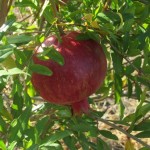
Ripe pomegranate
Last month, I froze cubes of butternut squash in freezer bags and readied pumpkin flesh for pie. While picking a few ripe persimmons recently, I noticed that we’re sharing them with a visitor who seems to sneak in and munch during the night. I’m thinking the culprit could be a raccoon, opossum, skunk, squirrel, fox, or a gaggle of wild turkeys that seem to make an annual pilgrimage through our area.
The two main types of persimmons grown on our farmette are Fuyu and Hachiya. The Fuyu is rather squat-looking and Hachiya has an elongated shape. Both take on a bright orange color in the fall. When fully ripe, Fuyu is sweet and crunchy like an apple whereas the Hachiya is soft like jelly. Though commonly thought of as fruits, persimmon and pomegranate are technically berries.
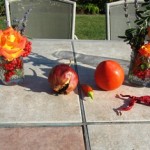
Pomegranate and persimmon are plentiful this time of year
Fuyu persimmons can be peeled, sliced, and eaten fresh, roasted, or tossed into salads. They add a vibrant splash of orange to a winter salad that could include slices of citrus and pear tossed with greens,walnuts, pomegranate seeds, and goat cheese.
Pomegranates are ripe when their leathery outer covering turns red and begins to crack. Inside each pomegranate is white tissue separating compartments of ruby-red seeds called arils.
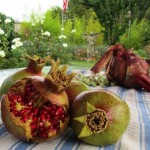
Ripe pomegranates hang heavy on the trees this time of year
The seeds are high in antioxidants that reduce inflammation and free radical damage. Though they are messy to remove, the pomegranate seeds are healthy and nutritious additions to any diet.
To preserve pomegranate seeds, freeze them on a baking sheet. Once frozen, slip the seeds into freezer bags and return to the freezer. The seeds can be kept frozen for months.
Pumpkins come in a variety of sizes and types. Personally, I prefer the sugar pumpkins for recipes calling for pumpkin as an ingredient.
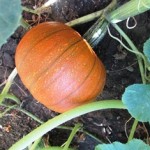
French sugar pumpkin are small but perfect for pies
This week as we prepare for the big feasting day of Thanksgiving, lots of cooks are already baking pumpkin pies. Many will use canned pumpkin as a shortcut to their pie preparation but pumpkin filling made from scratch is especially delicious.

Our pumpkin pie features leaves of pie dough, brushed with egg, and sprinkled with sugar before baking
The old fashioned way to make pumpkin pie from scratch is to use fresh, organic pumpkin puree from the produce that you’ve grown in your garden. The process to make a pie takes longer because first the pumpkin must be peeled, seeded, and cut into manageable pieces and then cooked down. Then just follow your favorite pumpkin pie recipe.
_________________________________________________________________
Taking care of yourself is one of the most important things you can do over your lifetime and it starts with healthy ingredients and fresh produce.
My newest self-help wellness book is THE SELF-CARE PLANNER, A Weekly Guide to Prioritize You.
My books are available for purchase through online and traditional bookstores everywhere. Buy The Self-Care Planner and other titles offered by my publisher, Simon & Schuster online. Visit my author’s page at https://www.simonandschuster.com/authors/Meera-Lester/2137649823

It’s never too late to get healthy and live a richer, fuller, and more meaningful life. Self care is not selfish but rather an act of love.
YOU NEED THIS BOOK. WE ALL DO.
Buy it now from:
https://www.simonandschuster.com/books/The-Self-Care-Planner/Meera-Lester/9781507211649
Check out more recipes and tips for healthy country living in my Henny Penny Farmette series of cozy mysteries (Kensington Publishing, NY).

This three-book series of cozy mysteries features elements based on the real Henny Penny Farmette
An Apple a Day…or a Slice of Pie
What could be a healthier self-care act than eating an apple? On my way to do chores yesterday, I bumped against the Fuji apple tree, knocking off several. After finishing my chores, I picked up the apples and plucked a few more to take back to the kitchen. Fuji apples (like Cortland, Macintosh, and other firm varieties) are crisp and juicy and hold their shape during baking. Plus, they’re good for you.
Apples are a rich source of dietary fiber and are loaded with antioxidants. They are considered among the healthiest foods because apples decrease the risk for diabetes and thrombotic stroke as well as lower levels of LDL or bad cholesterol.
According to research done at Cornell University, eating an apple a day may help prevent breast cancer. Some compounds in apples are thought to aid in weight loss and lower blood pressure as well.
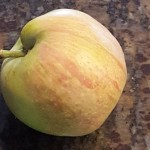
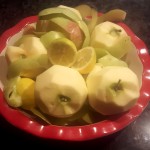
Inside the house, I ran through my apple recipes. Should I make pie, an apple crisp, crumble, kuchen bars, cake, or some other apple dessert? Pie seemed the simplest. Also, a pie only uses six or eight apples. I could keep the other apples as fresh snacks.
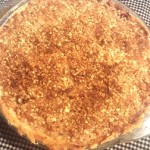
Instead of a regular pie crust, I made a pate brisee in my food processor and chilled the dough for a half-hour before rolling it out into the bottom crust. In lieu of a top layer of pie crust over the apples, I made a crumb topping using oatmeal and brown sugar with a little flour and butter.
The pie turned out delicious. The crumb topping added a little crunch to the softened apple filling and tender, flaky crust. I could have made it even crunchier with the addition of chopped walnuts or pecans.
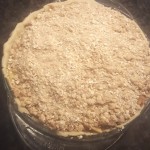
APPLE PIE with CRUMB TOPPING RECIPE
Ingredients:
8 firm apples, peeled, cored, and thinly sliced
1/2 cup granulated sugar
1 teaspoon cinnamon
Pinch of ground mace
Pinch of freshly grated nutmeg
2 Tablespoons of cold, unsalted butter, cut into small pieces
Directions:
Preheat the oven to 375 degrees Fahrenheit
Position your pastry round over an 8-inch pie plate and press in place. Trim the pastry and crimp the edges.
Toss the apple slices with the spices and sugar and fill the crust. Dot with the butter. Cover the apples with the crumb topping and bake for 45 minutes (cover with aluminum foil during the last five or ten minutes to keep the topping from burning). Remove from the oven and let cool before serving.
CRUMB TOPPING RECIPE
Ingredients:
1/2 cup (1 stick) cold, unsalted butter
3/4 cup dark brown sugar
1/2 cup all-purpose flour
1 cup rolled oats
Directions:
Place butter and flour in the bowl of a food processor and pulse until the mixture becomes like a coarse and crumbly. Add the oatmeal and brown sugar and pulse with the butter/flour mixture until combined. Cover pie with crumb topping.
____________________________________________________________________________________________________
Eating apples is a healthy practice for self care. If you want to learn more about making self-care a priority, check out my latest offering available this fall in time for holiday gift-giving: THE SELF-CARE PLANNER, A Weekly Guide to Prioritize You.

Learn how to schedule personal time to accomplish your dreams and goals for body, mind, and spirit. You’ll find prompts, reminders, and checklists to help you create and stick to your self-care routine. Put this book on your holiday list and find it online where books are sold and in traditional bookstores everywhere. This holiday season, remind yourself that self-care isn’t selfish. It’s an act of love.
Also, if you enjoy reading about country living, growing heirloom vegetables and fruits, and preparing delicious recipes, check out my cozy mystery series that is chocked full of craft ideas, foods, and wellness tips for humans and pets.
All novels are available online and in bookstores everywhere. They include A BEELINE TO MURDER, THE MURDER OF A QUEEN BEE, and A HIVE OF HOMICIDES (Kensington Publishing, NY).