You are currently browsing the archives for the Wildlife category.
Blogroll
 Facebook
 Goodreads
 LinkedIn
 Meera Lester
 Twitter
SITE VISIT COUNTER


Archive for the 'Wildlife' Category
Certain Plants And Chickens Don’t Go Together
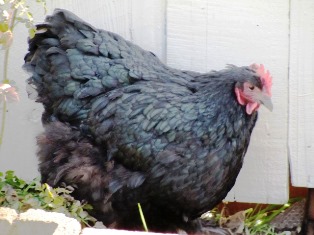
Chickens love scratching the dirt for culinary treats like seeds, berries, and grubs
Chickens are curious creatures. Spend a hour watching them scratch, poke, and peck and you’ll see what I mean.
I’ve never lost a free-range chicken because of something it ate; but it seems as though they’ll eat anything. It got me thinking that a variety of plants commonly grown in landscapes and backyard gardens could make chickens ill if they ate the berries, nuts, or leaves of those plants.
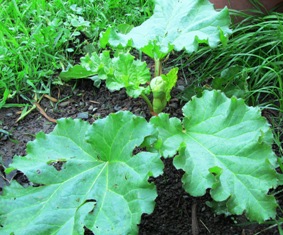
Rhubarb leaves are poisonous
The following represents a small sampling of common plants that could make your feathered friends sick or even poison them.
- Acorn
- Alfalfa
- Azalea
- Daffodil
- Eggplant
- Foxglove
- Hemlock
- Jasmine
- Jimson Weed
- Lamb’s Quarters
- Lantana
- Milkweed
- Nicotiana (tobacco)
- Oleander
- Oxalis
- Poison Ivy
- Poison Oak
- Pokeweed
- Pyracantha
- Red Maple
- Rhubarb
- Sweet Pea
- Tulip
- Wild Onion
- Wisteria
Chickens are foraging birds and have good natural instincts. They will taste a plant and if something isn’t right, they’ll likely leave it. If you allow them to forage for themselves in pasture, more often than not, they’ll eschew the poisonous plants in your garden or landscape for the rich diversity of what they find in open pastureland.
If Your Chickens Aren’t Cold Hardy, What Can You Do?
Chickens that can tolerate extreme cold are considered cold-hardy. The Dominique, Hamburg, Langshan, Sussex, and Wyandotte breeds are considered chill tolerant (even cold-hardy) but breeds such as Crevecoeur and Catalana are less tolerant of temperature extremes. So are Bantams and some breeds with large, single combs.
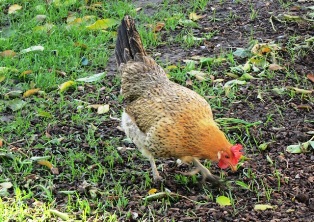
Small hen with a double comb
The chickens generate body heat that helps alleviate the cold temperature of a coop. They also wear feathered coats and will huddle together for warmth. A hen house that has insulation and perhaps a south-facing window that captures the warmth of a winter sun can also mitigate extreme cold.
Still, if you live in an area where the temps are below freezing, where it snows, and where the wind contributes to the chill, you might want to hang an ordinary light bulb (40-60 watts) or a 50-watt red bulb if you worry about frost-bitten chickens on those coldest nights.
Put that lamp on a timer. But beware of hanging any electric light that could get knocked down. It could set your coop on fire. And cold-tolerant breeds probably don’t need the extra heat anyway.
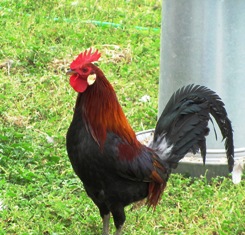
A Bantam rooster struts his stuff
Perhaps equally, if not more, important are the chickens’ need for fresh water, ventilation, and a dry environment during winter. You don’t want the chickens roosting in a draft, but you do need ventilation in the coop, for example, via egg-access doors, windows, or ventilation holes with screens. They also need a dry environment.
If the coop isn’t insulated, you might stack bales of straw or hay along the walls and scatter pine shavings if your coop has an earthen floor that becomes cold or frozen.

This chicken house has egg access doors, a human door, a window, and is insulated; the art is optional.
Cold-hardy chickens probably will make it through most frosty nights with few to no problems. Your best tool is your ability to observe your chickens for problems. Oh, and you might want to place a thermometer inside the coop for an accurate measurement about how cold it really gets when the ladies (and rooster, too) are all inside.
Don’t judge your chickens’ endurance for cold by your own.
The Woodpecker Saga Continues
The woodpecker is back and apparently intent on taking down our roof strut. As I’ve mentioned in a previous blog, I believe it is a Nuttall’s Woodpecker (Picoides nuttallii) and possibly a female because of its small size and lack of red color on the back of the head and nape of the neck. The bird was named for naturalist Thomas Nuttal in 1843. It doesn’t eat acorns, yet its habitat is California oak woodlands.
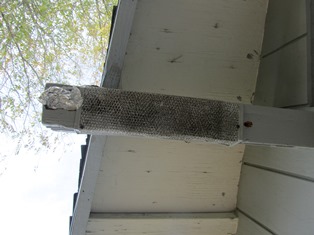
Aluminum foil stuffed into the hole hasn’t deterred the Nuttall’s Woodpecker
After making two holes large enough to all but obscure the creature pecking away inside the beam, the woodpecker took off after I shooed him away. But despite me screwing in a screen to cover the two gaping holes, the woodpecker has created two new holes and has made a heck of a mess.
My husband and I awoke to the rat-ta-tat-tating before daylight. After a quick inspection of the woodpecker’s drilling, Carlos told me to stick aluminum foil into the hole until he could return from work today and either saw off the dead wood and reinforce the beam or figure out another solution.
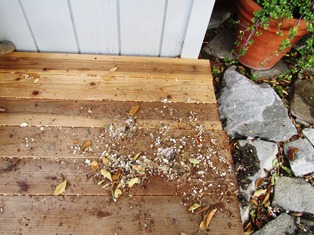
Shavings of wood, foam, and nesting materials characterize the mess on the porch
In the mess on the porch floor beneath the roof beam are what appear to be remnants of a nest. Is it possible that the woodpecker once constructed a nest inside that roof beam? They nest in tree cavities, so it isn’t too far of a stretch from a tree to a strut. This industrious female might be trying to create a nest for mating season (January to March), preparing for egg laying in April and May. And interestingly, the male incubates the eggs at night while the female sits on them during the day for a total of about 14 days.
While the woodpecker pecks, I’ve resigned myself to staying in the kitchen, baking our pumpkin and pecan pies for Thanksgiving. All the while, I hear the tapping of a drumbeat as the woodpecker either forages for food (it likes insects and spiders and some berries) or creates a cavity for a nest.
Drastic Measures to Keep the Woodpecker Away
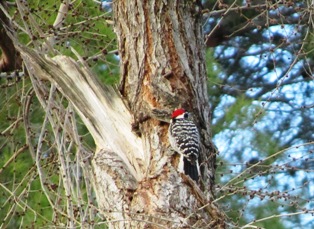
This lovely Nuttall’s Woodpecker has returned this year, perhaps to watch its offspring peck away at our roof strut
It’s been a week of rat-ta-tat-tat-tating and I’m growing wearing of hearing it. The woodpecker’s sound ordinarily doesn’t bother me, except I know it is pecking the foam, widening the hole of an exterior beam supporting the roof of this old house.
While my husband is away visiting relatives and I’m trying to keep the place tidy, the woodpecker isn’t going along with the plan. It is making a mess on the porch that rivals the squirrels’ messes when nuts are in season.
The bird has pecked wood shavings that fall into a pile on the porch. Worse, it is also pecking out the dry foam that we sprayed into the holes. Stopping the woodpecker’s assault against our beam forced me to take drastic measures.
When I heard the pecking this morning, I circled around the back of the house and sneaked along the side to catch the bird in the act. Seeing me, it took cover in the nearby elm tree.
From the bird’s size, I believe it to be either a female or a juvenile Nuttall’s woodpecker. We had one here last year that I photographed high in the pine tree. See http://www.allaboutbirds.org/guide/Nuttalls_Woodpecker/id
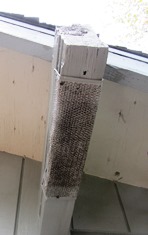
A screen bent to fit around the beam has deterred the woodpecker, at least for now
The solution, I think, might be a screen I found in a frame that clamps nicely over the two holes. Since securing the metal in place with screws, I haven’t heard a single rat-ta-tat-tat . . . not even in the nearby pine or the elm trees.
An Extra Blanket for the Bees
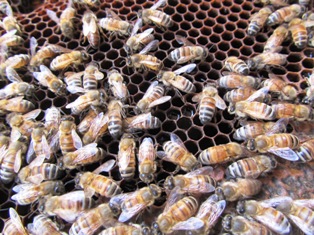
Honeybees will form a cluster near the center of the hive to generate warmth in winter
With Thanksgiving only a couple of weeks away, weather is turning downright frosty at night. I asked my beekeeper neighbor if it was time for us to throw some blankets over the hives to help the beleagured honeybees stay warm. We did this last year along with feeding the bees with a good result of thriving hives in the spring.
In the wintertime, the honeybees cluster toward the middle of the hive, their muscles responsible for flight now shivering (albeit in a different way than when taking flight), to generate heat. The colder it gets, the tighter the cluster and harder the bees have to work to stay warm. If the the core temperature of the hive drops too low, the colony will die. See http://indianapublicmedia.org/amomentofscience/honeybees-winter/
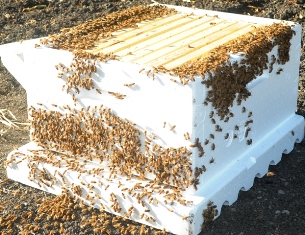
A super of honeybees with ten frames
During winter months, proper ventilation to maintain a dry hive is a must. Since bees eat and metabolize honey to generate heat, carbon dioxide and water are produced. The carbon dioxide, heavier than air, descends and exits the bottom of the hive while the water vapor rises to the cold inner roof and drips back down as condensate on the poor bees. Freezing and starvation can cause bee die-offs in the winter.
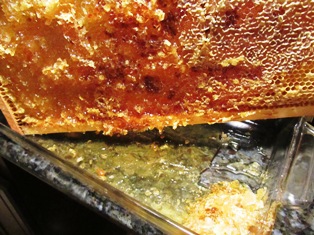
Bees eat and metabolize honey from stores within the hive during winter when outside food sources are scarce
We drape each hive with a blanket over the top and around the back and sides, but not in front where the openings are located. Bees need to be able to enter and exit. As soon as the temperatures warm, my neighbor and I pull back the blankets during the day.
Some might suggest that putting out an extra blanket for the bees is interfering with nature’s processes and survival of the fittest, but on the other hand, the colony has remained strong and healthy over this last year.
Human use of pesticides has wreaked untold harm on the population of these important pollinators. Isn’t it about time, we considered the plight of the bees and did something to help them survive, like planting excellent food sources for every season and giving them medicine when they need it an an extra blanket for warmth? See, http://www.mariasfarmcountrykitchen.com/help-honey-bees-survive-winter/
Remind Me Again, What Good Are Gophers?
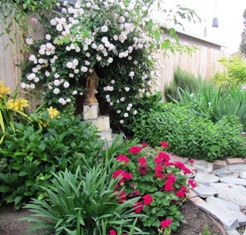
Cecile Brunner forms an arch over a statue of the Virgin Mary in one of the prettiest and most peaceful areas of my garden
The lovely Cecile Brunner rose that serves as the anchor for a small meditation garden on the northwest side of my little farmhouse suddenly appears yellowed, leafless, and lifeless. Honest to goodness, she looks like she’s croaked. It’s certainly a strange turn of events, since she had numerous new canes and the leaves were shiny and healthy only a week ago.
There is a small eruption of new dirt nearby–suggestive of moles (insect eaters) and gophers (vegetarians) and maybe voles–(voles eat roots but don’t leave mounds). So my rose problem might actually be two-fold–either way–it’s underground.
I could dig and back fill those tunnels with dirt and maybe I should. I’ve heard you can break a leg stepping into a gopher hole and I’m not talking livestock here. I wonder if the vole and gopher are sharing a network of tunnels down there dead-ending in the gopher’s bunker.
I gave the poor rose a big drink of water as soon as I discovered her condition, not knowing what else to do. As I stood there, watering with hose in hand, I saw the earth around the rose’s root cave in. Seriously?
So I’m thinking there must be a one heck of a big tunnel. This is war! I decide to stick the hose right into the tunnel and fill it with as much water as that hole will hold . . . and then some.
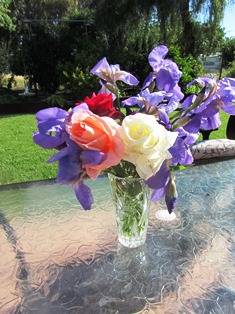
You might expect purple iris to bloom around Easter but in late October?
Strangely, while I’m dealing with the rose problem, I look past the fresh dirt mound and notice that one of the Dutch purple irises in a bed of a hundred or more has broken into full bloom. What gives? Those beauties normally bloom around Easter. I wonder why the voles haven’t attacked the rhizomes of the irises.
The condition of the Cecile Brunner climbing rose breaks my heart. Maybe she’ll spring back to life to bloom again next spring. For now, I’ll clip the beautiful iris and tuck it into a vase with some roses from other bushes on the farmette. That done, I’ll put an all-out effort into finding out how to get rid of those underground buck-tooth bandits . . . for good. Feel free to leave me your ideas. I’ve tried almost everything I’ve read on the Internet.
An Unwelcome Visitor for Brunch
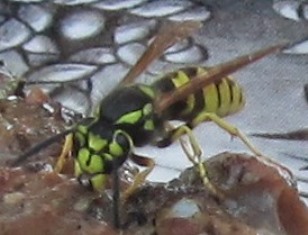
When this yellow jacket dropped in on my Sunday morning brunch plate, I took off
I welcome visits into my yard by honey bees–they are not interested in me or my plate of food (unless it has honey on it), but hornets, wasps, and yellow jackets are not welcome.
This past Sunday morning, I was enjoying a plate of food on my patio when a yellow jacket made an unwelcome appearance. These are the yellow and black predatory wasps you find on your soda cans and sweets at picnics. Some people call them “meat bees” but they are actually wasps.
What value are they to gardens, you might wonder. I did. Although I loathe them, I did a little research and discovered that yellow jackets are predators of insects that many of us gardeners consider pests. But try as I might, I just can’t make myself like yellow jackets. The females don’t just sting and die. They can sting multiple times. And wasp stings hurt.
About those stingers–they are like lances with barbs, injecting venom into you during a sting. The stings are not dangerous unless you happen to be stung repeatedly or you are allergic to bee and wasp stings. In that case, you might carry a epinephrine autoinjector (known as an EpiPen) in the event of a life-threatening sting to treat anaphylaxis.
Keep a lookout for yellow jackets in the spring when the queen seeks a place to construct a paper nest. These wasps (related to hornets) live in social colonies with female queens and workers, and also males, known as drones. They like to establish their nests in hollowed logs and human structures (like houses with holes for entry into attics or walls). They enjoy a diet rich in sugar and carbohydrates. Don’t we all? But take care when enjoying your al fresco Sunday brunch. You never know who might drop in!
Those Entertaining Rascals, the Sparrows
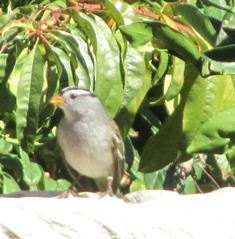
A white crown sparrow on the birdbath studies food foraging options in the garden
I enjoy watching the sunrise over the hills that jut up between the inland valley of the East Bay, where I live, and the waters of the delta flowing down from Sacramento to dump into the Straits of Carquinez before entering the San Francisco Bay. A lot goes on in our backyard garden at sunrise.
With feeders filled with birdseed, all sorts of songbirds visit to eat before bathing in the bird bath perched in a raised bed of blooming geraniums, asparagus ferns, and foxglove flowers. The squirrels search feeders for sunflower seeds. And clusters of house sparrows twitter away as they forage for seeds, insects and other interesting morsels to devour.
These cutie pies descend to the lawn as soon as the sun is up. They bathe, drink, and eat, often stealing food from other birds. A robin with a beak full of worms better take heed of the presence of sparrows or those little cheep, cheep, cheepers will steal the food right out of the robin’s beak.
The sparrow’s thievery isn’t limited to food; no, it will also steal nesting material from each other’s nest. But these scrappy little fellows will just as readily engage in their birdbrain version of fisticuffs as they will dart into trees for cover.
Without a doubt, of all the birds that are visiting the garden of late, the sparrows provide hours of entertainment.
Attracting Butterflies into Your Garden
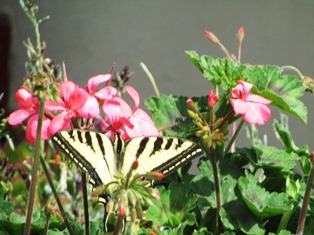
The Western Tiger Swallowtail, shown here on geraniums, resembles its counterpart, the Eastern Tiger Swallowtail
While sipping my morning coffee today, I spotted a Western Tiger Swallowtail butterfly in my garden. So naturally, I had to put down my mug of coffee and grab my camera.
These beauties have wingspans stretching up to four inches. The butterflies are often seen in woodlands around streams and riverbanks or canyons in the west. For a complete list of butterflies for Northern California, see http://www.thebutterflysite.com/california-butterflies.shtml
Here on the farmette, these beautiful butterflies feed on the nectar of the garden plants. I often see them on the blooms of my hedge of lavender and elsewhere on the zinnias. They also flit over and and perched on the water fountain near where I grow roses and wisteria.
You can attract these particular butterflies into your Northern California gardens by planting petunia, Mexican sunflower, dianthus, and the butterfly bush. But do a little research on creating a butterfly garden if you want to attract different types of butterflies. And don’t use pesticides or insecticides if you are serious about creating such a haven.
Forget the Lawn and Welcome the Robins
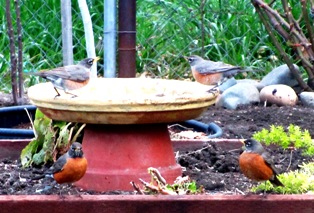
Robins are the quintessential backyard bird
One of my favorite ways to relax is birdwatching. And nothing entertains me more than seeing an orange-breasted robin hopping around on the lawn and then halting at a full stop with its head cocked as if listening for an earthworm, as if the worms telegraphed their presence. I mean seriously. But somehow, those robins will find the worms and pull them right out of the ground.
When winter is nearing its close and spring is beginning, the robins are one of the first harbingers of the seasonal transition. In the spring, when other backyard birds are nesting and producing young, the robins are, too. But even though it is possible for them to produce three broods each year, less than half (40 percent) of their nests will hold baby robins.
Of the young robins that hatch, only about a quarter of them will make it to November each year. And as if that weren’t bad enough, of the robins that make it through a full year, only half will survive through a second year. And yet, robins can live to the ripe old age of 14 if it were not for predators and pesticides.
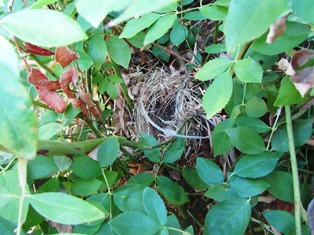
Robin nest tucked into a Cecile Brunner polyantha climbing rose
With the odds against these sweet birds’ survival, you’d think most people would not spray the daylights out of their lawns with pesticides and herbicides. These chemicals are toxic to the robins as well as other birds and, of course, the beleaguered honeybee.
Robins find lawns to be wonderful sites for foraging and I often see them searching and snatching the earthworms in the early morning. Later in the day, these cheerful birds seem to prefer fruit and honeysuckle berries. If you don’t see them, you might hear their cheery song crisp and clear, even over urban noise.
During certain times of the year, you might see the robins in greater numbers than at other times, but that doesn’t mean they’ve gone far. They are either resident birds, meaning they stay close to their breeding area or are short-distance migrants. The local conditions (environmental, weather, water and food availability, predator populations, and other factors) dictate the size of the robin population in at any given time in a particular area.
If you love birds as I do, less fussing over your lawn (except to encourage the worms) might mean having having more robins around. Consider ways to establish a healthy ecological balance in your yard and garden to avoid spraying with chemicals that can poison these cheerful fun-to-watch birds.