You are currently browsing the archives for the Wildlife category.
Blogroll
 Facebook
 Goodreads
 LinkedIn
 Meera Lester
 Twitter
SITE VISIT COUNTER


Archive for the 'Wildlife' Category
Outwitting the Moles
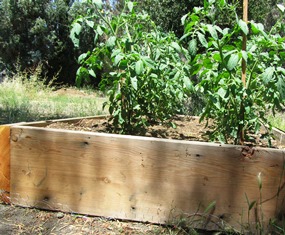
Tomatoes can grow well in raised beds like this wire-bottom box to deter moles
Last year, our garden went under siege to moles, voles, and gophers. They drove us crazy with tunnels, tracks, and earth mounds–the means to devour our newly planted bulbs and plants. We didn’t see signs of the voles but we knew we had them, too, when one showed up drowned in a post hole after a rainstorm.
But whether the rodent is a gopher, vole, or mole, they are unwanted pests in my garden. This year, my husband and I decided they could roam around if they wanted, but we were going to protect our plants one way or another.
For our heirloom blue tomatoes, Carlos built four -by-six feet boxes to hold soil. For each, we nailed small-hole poultry wire over the bottom, then flipped the box over to set in place on the ground.
We then filled the box with alternating layers of natural soil, compost, and dried horse manure (any type of manure must be dried and aged or it’ll be hot and kill your plant).
We planted, staked, and watered the tomatoes. We’ve seen no evidence of rodent tunnels despite having planted in an area where we know there are tunnels. We’re thrilled with the result. I just may have to do my whole garden in boxes next year.
Dealing with a Flock of Stressed-Out, Feathered-Out Chicks
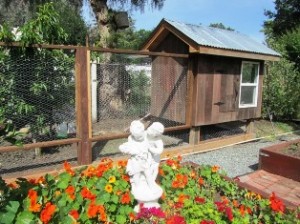
The chicken house and fenced-in run keep the hens safe from hawks and other predators
Now that the weather has turned warm here in Northern California, I have moved my baby chicks from the huge box in my kitchen to our newly constructed chicken house. I don’t know for certain, but I think they were feeling stressed out in the box and I was stressed from the noise and their behaviors of pecking each other and trying to fly out of the box.
The hen house has two windows that open and close for ventilation, nesting boxes, a front door for my access, a back exit door with stairs for the chickens to enter and leave, and a couple of perches inside and out. We wired a poultry screen over the top of the chicken run because of the predatory habits of local hawks.
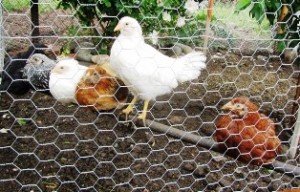
A few of our flock of eight baby chicks, now with feathers
Our chicks range in age from eight and ten weeks and are all feathered out. I feed them medicated crumble and provide fresh water daily. To ensure strong legs, I cover the chicken house floor with a bed of dried, crushed corn cob. I also have stuffed straw into the three nesting boxes so that when the chickens are ready to begin laying, they’ll have a bed ready.
The chicks are growing so fast, their girth and height seems to double every week. The bulk of their diet is crumble, but with an occasional treat such as shredded fresh lettuce and spinach leaves. Their activities and often-flighty behaviors are notable for chickens. They take dust baths, scratch the earth for grubs and worms, run at each other while seemingly intent on crashing only to avert at the last minute, perch together to roost, and peck their housemates. Oh, the pecking!
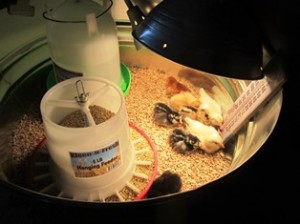
When they first arrived, we put the chicks in a tub in the kitchen, later moving them to a box
Guess which chicken is the most aggressive pecker from my flock that includes White Leghorn, Silver-Laced Wyandotte, Buff Orpington, Rhode Island Red, Black Sex Link, and an Ameraucana. Turns out,in my flock, the most aggression is shown by the Buff Orpington.
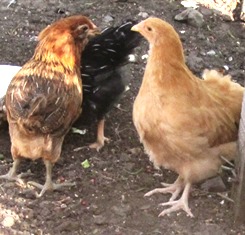
Face off over a sliver of fresh spinach: Ameraucana on the left, Buff Orpington on the right
From day one, “Buffy” has pecked the quiet Ameraucana. Before the Ameraucana had feathered out, blood would flow from her back from Buffy’s senseless pecking. I tried to separate them, giving Buffy time outs and hoping to stop her behavior. It seemed to work . . . or, maybe I was just imagining it was.
I placed a dab of antibiotic cream on the back of the Ameraucana and within days, her pecking wound healed and now she’s feathered again over the wound. The move to the chicken house reduced the stress of living out of a box in the kitchen. Now the chickens seem to get along fine, even enjoying their life in the hen house.
Last night, Buff huddled up next to the Ameraucana on the roost and this morning I saw the two of them taking a dust bath together. Chicken stress relief. My stress relief. It’s a beautiful thing!
Swarming Season Has Arrived!
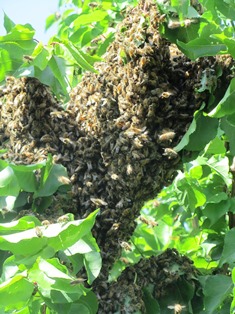
Honeybees cluster in a temporary location (apricot tree) during a swarm
What’s not to love about spring? It’s only the middle of April and already we’ve seen several honeybee swarms. Swarming is how the bees reproduce their colonies and most often occurs during the warm days of early spring.
My neighbor, whom I’ve often called a world-class beekeeper (his father kept honeybees in Lebanon and taught him well) permitted me to keep his bee swarm that alighted in my apricot tree. He also generously donated a super (hive box) with some frames that already had wax, honey, and capped brood–all from his own apiary.
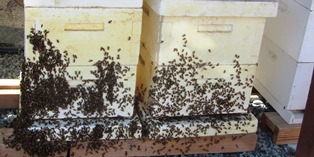
Bees outside the hive boxes on a hot day
The newly housed honeybee workers delight in foraging on the various types of lavender (Spanish, English, and French perfume) that I’ve planted around the farmette. The colony will build up the wax and make honey while the nursemaid bees will care for the brood.
My husband, the architect-turned-farmer/beekeeper, has constructed a unique bee house for the hives. It will keep the bee boxes dry during winter rains and out of reach of marauding animals (skunks and raccoons). Resting on a platform that Carlos built on top of a newly installed brick floor, the hives are not within easy reach of the ever present ant population.
Alas, the bees weren’t about to wait until Carlos finished building their house. The swarm happened when the bees were ready to take flight (some 60 percent of the workers with their old queen) flew into our apricot tree.
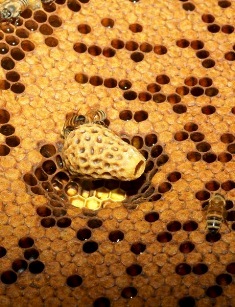
The thimble-shaped cell houses the special bee who is fed royal jelly until she emerges as queen
If you see a swarm, call your local beekeeping association (or any store that carries local honey) for the name of a beekeeper. Avoid the temptation of spraying water or anything else on the swarm. Permit the beekeeper to safely remove the swarm.
For a beekeeper, rescuing a swarm is a truly exhilarating experience. Often a swarm consists of thousands to tens of thousands of honeybees. Beekeepers routinely rescue swarms from where bees have temporarily clustered while the bee scouts seek a permanent home. The beekeeper can shake them into a prepared hive box, leaving the box at the hive cluster site until all the bees are inside. At that point, the beekeeper takes the new hive to his apiary.
The beleaguered honeybees (whose populations have been decimated by the Varroa mite, weakened immune systems, and Colony Collapse Disorder) need help to survive and increase their populations. We need them, too! Without their pollination of fruit, nut, and other crops, our own food sources diminish.
Saving the honeybees is a good practice whenever possible because doing so ensures abundance and diversity in the plants we eat. Whenever I see a cluster of bees in a tree I feel joyful and celebratory. Is it any wonder that swarming season is my favorite time of the year?
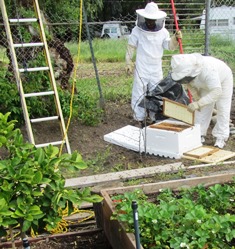
Two beekeepers rescue a swarm from high in a pepper tree
Chicklet Therapy: Raising Baby Chicks
I’m raising a flock of baby chicks in a tub in my kitchen. Watching them is nothing short of a stress-busting exercise. Not only do they provide endless entertainment, but they already show individual temperaments and personality traits that can’t help but make you smile.
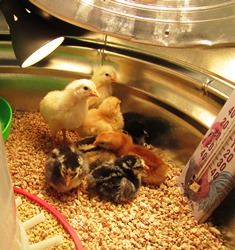
A flock of babies huddle under lamps for warmth next to a thermometer
Some people raise backyard chickens for both meat and eggs. Others want only eggs (I’m in that group). And there are those who love keeping the more exotic breeds–imagine feathered legs and toes, cheek muffs, beards, and strange-looking combs.
There are so many breeds, it’s hard to keep track of them all. For example, there are the standards like the White Leghorns and Rhode Island Reds; the exotics like the Faverolles (with their five toes, feathered feet, and fluffy beards and muffs), and heritage chickens.
Traditional breeds or “heritage” chickens aren’t as popular as they once were, so their numbers are declining. Some are even considered Of the heritage chickens whose numbers are declining so rapidly that they are considered globally endangered. They include Campines, Andalusians, Buttercups, Catalanas, Sumatras, and other breeds.
My baby chick choices include a Rhode Island Red, a Buff Orpington, two Silver-Laced Wyandottes, two White Leghorns, a Black Sex Link, and an Ameraucana (who lays blue-green eggs). All are known to be good layers, although some are more productive than others.
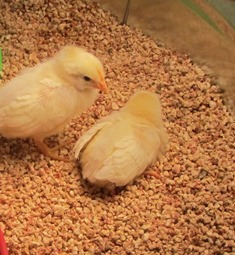
One White Leghorn chick to another: “Let’s make a run for it!”
Egg production can go down during periods of molting (losing their feathers) or broodiness (sitting on the eggs as though they will hatch, which they won’t because without a rooster, the eggs are not fertile). Also, egg production can decline during winter when the daylight hours are shorter.
The following guidance comes from my local feed and pet supply store, Concord Feed, Pet, and Livestock Supply. See, http://www.concordfeed.com. The store’s capable staff are all extremely knowledgeable about chicks. Here are the guidelines.
1. The environment must be clean, warm, and dry (no drafts). Consider a brooder’s box or large galvanized tub filled with dry and mold-free bedding such as corn cob shavings (Bed-O-Cobb is a good one). Avoid smooth, slick surfaces that can cause leg damage.
2. They must have room to roam. The rule of thumb is 1 square foot per chick; when they are six weeks and older, given them 2 square feet per bird.
3. Day-old chicks need 90 to 95 degrees Fahrenheit. To achieve this, attach a heat lamp or light bulb about 20 inches above the chicks. When cold, the baby chicks tend to huddle together under the lamp for warmth; when hot, the chicks move to the corners. You will want to reduce the temperature created by the heat lamp by five degrees each week until you reach the ideal temperature of 65 degrees Fahrenheit. Simply move the lamp further away from the chicks.
4. Hydrate the chicks with a one-quart of fresh, cool water in a dispenser that is changed daily (or more often if they scratch bedding or food into it). A quart container will provide enough water for 25 chicks.
5. Feed the babies with a chick starter until they are 16 to 20 weeks old. By that age, they should be feathered completely. Then begin giving the hens a laying feed to help them produce strong-shelled eggs and provide them with the nutrients they require.
By following these guidelines, I think I’ll be able to have eggs from my little hens by August or September this year, barring any of them turning out to be roosters. In case I must give him up (some cities don’t allow roosters), which I wouldn’t want to do, I’ve already talked to the feed store about rooster rescue organization. For helpful information about keeping chickens, see http://www.backyardchickens.com/
Have You Planned Your Garden Yet?
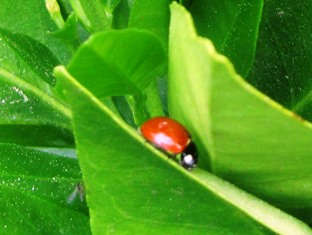
A Convergent Lady Beetle hunts for aphids on a citrus leaf
Ladybugs and honeybees occasionally meet on the same leaf when both forage for food. The ladybugs dine on aphids while the honeybees seek the sweet nectar of blossoms; orange, tangerine, and lime trees are favorites.
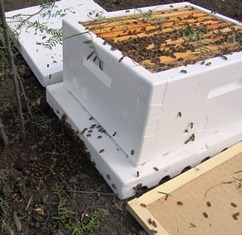
Styrofoam super with wood frames and bees
The bug and bee traffic has been steadily increasing now that showers and warm weather have triggered blossoms opening on the fruit and citrus trees around the farmette.
Spring doesn’t officially begin until March 20, but with the weather forecasters predicting upper 70’s Fahrenheit later this week and nighttime temperatures in the 50’s, it is time to consider options for your garden. Many DIY centers are already offering vegetable seedlings, herbs, and berries for planting. Some have markedly discounted their bare-root fruit trees and roses.
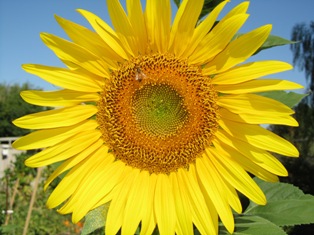
Sunflowers can be planted now in Bay Area gardens
I’ve already planted seeds in flats for germination and scattered flower seed (collected from last summer’s flower garden) around prepared beds. When the outside temperatures start to climb, I’ll be rewarded with blooms from nasturtiums, petunias, zinnias, and sunflowers.
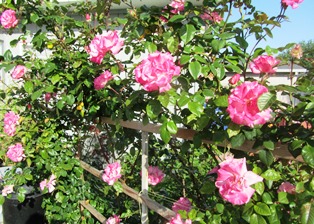
Handel climbs on a support, providing color from spring to fall.
The climbing roses are already past the red-leaf stage and are producing the first flush of blooms for spring. The wisteria vines have plump pods ready to unfurl with gorgeous tracts of purple blossoms. And the first green tips of leaves are beginning to sprout on my apples even as the early peaches and apricots already have fruit forming.
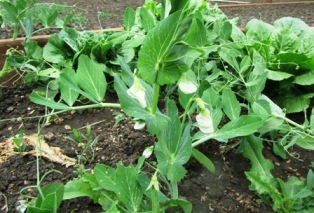
White blooms herald tender pods of sweet spring peas
This time of year holds the promise of new beginnings, and you see that in every step you take in a garden. Because I prefer to grow plants from varieties of heirloom, open-pollinated seed, I save it from the best specimens grown in the previous season. Of course, some plants freely re-seed themselves. That’s why I now find lettuce and onions and even sweet peas coming up in expected places on the property.
Have you figured out what veggies, flowers, fruits, and berries you’ll plant and grow in your garden this year? If not, now’s a good time to get started. For ideas, check out, http://www.organicgardening.com/learn-and-grow/plan-beautiful-vegetable-garden.
If you prefer, as I do, the non-GMO and organic seeds, there are many excellent sources for them. For heirloom and rare seed, check out http://www.rareseeds.com/store/vegetables/. Also see, http://www.victoryseeds.com/aboutus.html and http://www.anniesheirloomseeds.com/
Hummers Behaving Strangely
The tiny hummingbird with the dazzling red ruby throat announces its presence with a loud chirp that sounds something like a melodic drop of water.
It rises to heights in the air where it almost disappears to the naked eye and then dives to the ground, swoops in a U shape and rises again . . . over and over while a female watches from a nearby tree. Could this be a courtship ritual or a territorial display or both?
Actually it can be a little of both. The hummer’s spectacular displays of flight and air acrobatics often occur in areas rich in nectar sources. The incredible air acrobatics demonstrate the male hummer’s flying prowess to females. Their rapid wingbeats sound like a hum or whir. And they create another distinctive sound with their tail feathers.
While the females dine, the male hummer will chase away any intruding males until he can mate. He will mate with more than one female.
Once mated, the female will build the tiny nest using spider webbing as the glue to hold together a nest made of lichen, animal hair, and plant material. She has little to do with the male after mating; her focus is on the nest and eggs.
Here on the farmette of late, we’ve seen several hummers, but most often, the exquisite ruby-throated hummingbird (Archilochus colubris). The female will lay two eggs in a tiny nest that will be difficult to detect because of the lichen.
She will incubate the eggs for two-weeks or slightly longer, sitting on them for around 55 minutes of every hour until they hatch.The babies will remain in the nest for three weeks, when their body mass and maturity is sufficient for them to begin to forage on their own.
If you are curious about how a male hummer creates a distinctive sound using his tail feathers during courtship rituals, see the Science Daily article at http://www.sciencedaily.com/releases/2011/09/110908145053.htm.
To attract hummingbirds into your yard or garden, plant bright-blooming flowers. They select flowers for nectar that are bright and colorful such as salvia, columbine, honeysuckle, and bee balm.
Ensure a fresh supply of water in a fountain or birdbath. If you build or buy a birdhouse, aim for one with a small hole and secured at a height not easily accessible to raccoons and cats. Then when the fruit trees blossom and flowers begin to show, watch for hummers to begin behaving strangely.
Telltale Signs of Spring
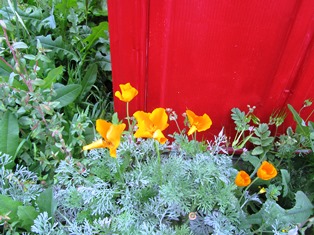
California poppies are beginning to bloom around the farmette
As I write this, the honeybees are scouting every plant on the property. Awakened by warm weather and sunlight, they search for nectar. Aside from a few California poppies and other wildflowers blooming in front of the house, they won’t find much to forage on just yet.
Of course, there are a few apricot, nectarine, and almond tree blossoms as well as a smattering of white strawberry blooms in the raised beds at the back of our property. But within a few weeks, the warm weather of March and April will render the farmette virtually covered in masses of sweet offerings for the honeybees.
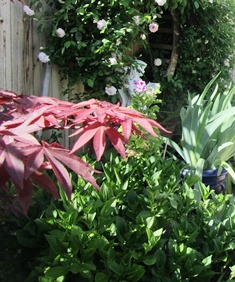
The leaves of a Japanese red maple add color to our early spring garden
Still, there are the early signs of spring. The Japanese maples are leafing out in a dazzling show of red color. The pregnant stems of our bearded iris are swelling now for their Easter bloom cycle. And the Greek oregano is popping up everywhere as it does this time of year.
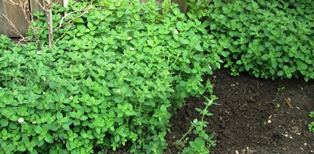
Greek oregano self-seeds all over the farmette
Birds are building nests, but I haven’t seen the red-breasted robins just yet. When they show up, searching for worms and grubs, I will know spring has truly arrived. Until then, I look for the telltale signs that Mother Nature is about to robe herself in the splendid garments of spring–fruit tree blossoms, leaves, blooming wildflowers, and lovely kitchen herbs pushing up all over the place.
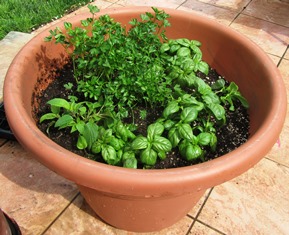
Herbs, like basil and parsley, can be grown in a pot for use in the kitchen
Pair Bonding and Nest Building Is for the Birds
Nothing is sweeter to this farmette owner’s ears that the trills, tweets, and peet-a-weets of the backyard songbirds. Of late, we’ve been highly entertained, especially since the male songbirds seem to be in courtship mode, singing and doing air acrobatics in an effort to woo a female into bonding with them. Nest building comes after that.
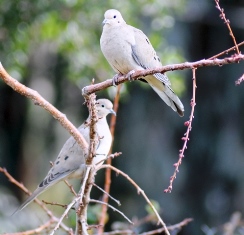
Mourning Doves mate for life; these two are joined at the feeder by a third who has lost her partner
The Mourning Doves sound their plaintive call during flight or at rest on a wire waiting for the right time to alight on the ground, which is where they prefer to feed. Lately, however, I’ve seen a pair feeding together in the tight space around a feeder. Of late, a third has joined them.
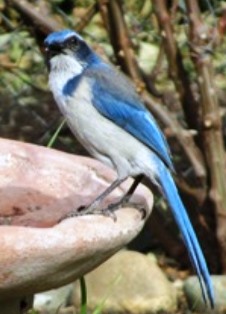
Jays are notorious for finding acorns and other nuts and burying them all over the yard
The Western Scrub Jay isn’t really a songbird. He competes with the mockingbird, who is especially vocal, for the highest perch in the tree where it sits lookout and squawks until it spots an acorn and swoops down to take it in its beak for burial, most likely somewhere in my yard. At first, we saw only one or two jays and now there are four or more hanging out near the many feeders and suet cakes that we’ve hung for the birds.
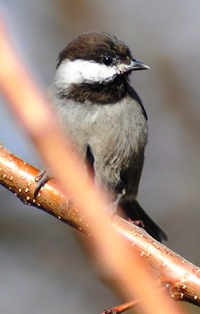
The Gray-headed Chickadee’s habitat is in northwestern Canada and Alaska, so what’s it doing on a Bay Area farmette?
The above bird passed through and posed long enough for a picture in our apricot tree. We think it is a Gray-headed Chickadee, but when we look the bird up in the Audubon book, it seemed unlikely since that bird doesn’t travel through Northern California. Still, the image of our bird seems to match exactly that of a Gray-headed Chickadee.
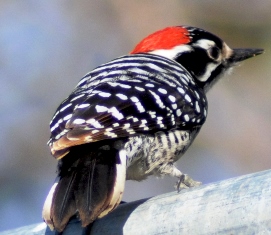
A male Nuttall’s Woodpecker loves dining on the suet cake hanging near our pepper tree
The flashiest bird of all in our backyard hangs upside down at the suet box, pecking away at the embedded seeds and pieces of fruit in the suet cake. He’s the Nuttall’s woodpecker and he’s found a mate. She’s hanging around, scouting out nesting sites. We’re trying to deter them from using a hole in our old farmette roof strut, but I think we’re losing the battle. Every morning, we hear the rat-ta-tat-tatting of bird beak against wood near the front porch. I’ve covered each hole they’ve made, but they keep drilling new ones.
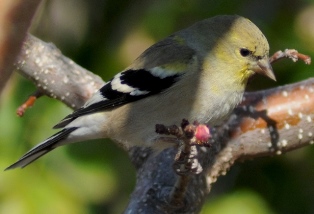
The Pine Warbler perches contentedly in the apricot tree after dining on insects, bugs, larvae, spiders, and caterpillars as well as the fruit and seeds embedded in the suet cake
Another bird that proved difficult for us to identify is the above pictured Pine Warbler. We have a massive pine tree in front of the farmette and with the suet cakes hanging at the back, this guy must have moseyed from the tall pine tree to drop in and taste a bit. These birds sing a rapid 10 to 30 notes at a time, usually on one pitch. Like most songbirds, they have song and also have defensive sounds, like a rattle call or a short, sharp note they sound to warn of predators or danger.
Yellow-Rumped Warbler and Other Songbirds Act Like It’s Spring
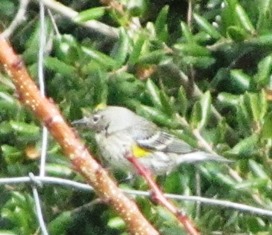
A yellow-rumped warbler has dropped by, pausing long enough for a Selfie
It’s the middle of January but tell that to Mother Nature whose songbirds are singing like it is spring. With our temperatures expected to exceed 70 degrees Fahrenheit in parts of the Bay Area today, the birds are gathering around feeders and fountains and the bees are buzzing about, too.
While having coffee on the patio this morning, I had the privilege of being visited by a variety of winged friends, some seemingly oblivious to me and my camera.
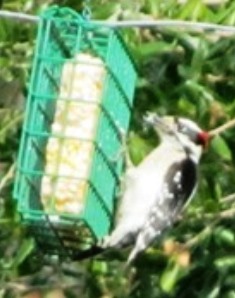
Our resident woodpecker snacks at the suet feeder
The woodpecker announces himself with the familiar rat-ta-tat-tat while the yellow-rumped warbler and other songbirds hang out in the firethorn bush, in the oak trees, and at several fountains we’ve placed at the rear of our farmette.
There’s a lot of bee traffic today. With warm days forecast for the next week or two, the bees could get the wrong idea and swarm. That would undoubtedly surprise the local backyard bee hobbyists.
Blue jays like the suet (fat and seeds) and a drink afterwards, sometimes also bathing in the water
So while I love the warm weather–especially when I read about the polar temperatures causing such misery in the Midwest and along the East Coast–like many Californians, I am beginning to worry about the looming possibility of a drought this year and mandatory water rationing.
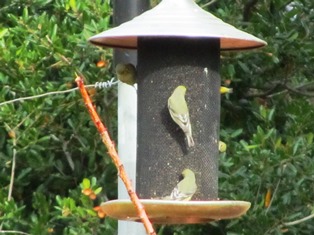
Finches love Nyjer seed and hang around when the feeder is full
But, then again, there’s something magical about hearing songbirds trilling in the dead of winter when the fruit trees in the orchard and the roses lining the path to the front door remain soundly asleep. I think I’ll have another cup of coffee and sit for a while longer.
Preparing for an Early Spring
It’s winter. The nights are cold and the early mornings even colder. But here on the farmette, daytime temps are still unseasonably warm for this time of year in Northern California. That makes doing all the winter cleanup and spring preparation chores not only tolerable, but enjoyable.
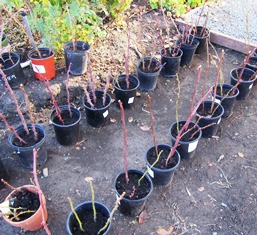
Rose cuttings will render new bushes on the farmette
We’ve pruned all the roses and taken cuttings for propagation of new bushes that we’ll plant around our property. We’ve divided the irises and planted the babies in new beds. Finally, we tackled pruning the fruit trees and imagine how shocked we were to find our Desert Gold peach trees with buds ready to open. The reason must be the warm weather.
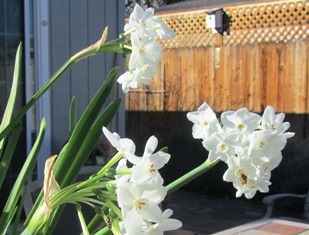
The honeybees are searching for blossoms and finding none, they’re exploring the papaperwhite narcissus on my patio table
The honeybees are searching for flowers in bloom. They’ve flown to the citrus trees that I’ve covered against nighttime freezing temps and are wandering about on the blankets. The French perfume lavender still has some blooms but the bees seem also interested in the paperwhite narcissus blooms that I forced in water between Christmas and New Years Day.
We’ve moved the strawberries to a newly prepared bed in two planter boxes and are revitalizing the soil in the old boxes. Bare root season is around the corner and my husband and I are feeling the pressure to get the garden ready for a new growing season. The days are lengthening and we don’t want an early spring to catch us unprepared. Technically, winter has only just begun but the birds and bees and buds on the trees are suggesting it could be a short winter.