You are currently browsing the archives for the Wildlife category.
Blogroll
 Facebook
 Goodreads
 LinkedIn
 Meera Lester
 Twitter
SITE VISIT COUNTER


Archive for the 'Wildlife' Category
A Hawk Drops by to Visit the Chickens
Nightmarish as it seems, I didn’t fear the hawk swooping down from the pine tree onto the fence. Nor did I worry when it perched next to the chicken run this morning.
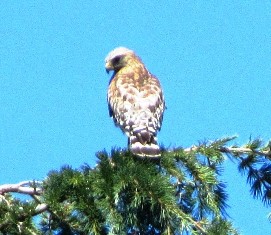
A sharp-shinned hawk on top of a nearby pine tree keeps an eye on my nine chickens
The poor chickens, who have been visited by foxes and other predators of late, deserve to be safe. To alleviate my own worries about the eight young layers and Mystery (the old Cochin), I’ve stretched poultry wire over the top of the run and strategically placed sheets of corrugated aluminum over potential entrance holes that animals could climb down, dig under, or fly through.
The brazen sharp-shinned hawk wasn’t deterred to see me this morning, but it didn’t approach the top of the run because there is no entry point from above.
Just as quickly as the hawk had landed on the fence, it flew away. The chickens went back running around the enclosed run, testing their own wings as they usually did each morning after being released from the hen house.
My girls are heritage breeds, so retain the flying ability that has been bred out of farm-factory chickens that are meant to only to lay eggs or be sold as meat to consumers.
I’ve lost chickens before to predators and ending up crying for days. I take full responsibility for raising my animals in a humane and loving way and I protect them. It’s the best way. For me, it’s the only way.
Outfoxing the Foxes
The chickens made such a ruckus this morning, I thought they were having trouble with a rodent in the hen house. My architect husband built the sturdy hen house off the ground.
He installed windows for air circulation and to cool off the chicken house at night. Good idea, we thought. Maybe not.
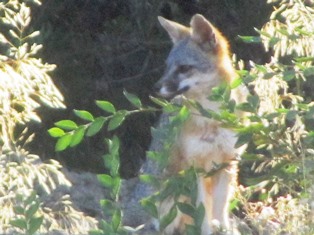
One of three gray foxes that have been checking out the chicken house at dawn and in the late evening
The windows open (to let out the heat) through screens. But foxes and open windows present a clear and present danger for the chickens.
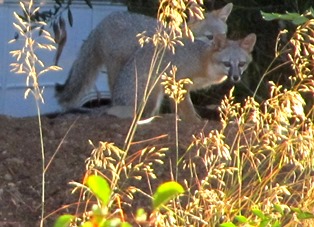
We believe these two are gray fox pups
When I first spotted the foxes on the uninhabited acre of land behind our farmette, I put extra poultry wire over the chicken run and over the hen house windows.

Fox pups play while their mom keeps watch
Each night, I secure the iron gate between the properties. The foxes were close this morning. I couldn’t say whether or not they’d go over the fence, but I took some shots with my camera before they spooked and left.
To outfox the foxes, I added extra roofing to the chicken run and inspected the fence all around to make sure there were no holes or weakened areas where the foxes could dig under.
We’ve placed a call to the local wildlife shelter and are hopeful that a representative can help us understand why the foxes are in an urban area (maybe in search of water and food during this intense drought) and whether nor not they will rescue the lovely little gray fox family, which is our hope.
Little Foxes on my Front Porch
The heat drove me from bed this morning around 6 a.m. Northern California is in the midst of a triple-digit heat wave and there’s not much relief at night.
I made coffee, as I always do as soon after rising, and peeked out the back sliding glass door. I can see into the chicken house because my husband installed windows. The chickens were still on the roost. I’d have time for a swallow or two of coffee.
Then I heard what sounded like a knock at the front door. Padding across the living room in bare feet, I opened it, half expecting to see my daughter (also an early riser; she likes making runs to Starbucks for her coffee).
It wasn’t my daughter. It was a small fox. The poor thing seemed as startled to see me as I was to see it.
When the fox bounded off the porch, I saw the other two. Yes, there were three–a whole family–in my front yard. Perhaps they came down from the hills of Mount Diablo to search for water or food . . . so back to the chickens I went.
Certain that there was no way for the foxes to get into the chicken run, I let the hens out; gave them food and water. Then, after searching the property for those little foxes, I went back to enjoy my coffee while the sun rose to begin roasting the Bay Area.
Gunshot Triggers Howls and Cackles in the Hood
Farm life isn’t always quiet. Night before last, a shot rang out around 11:00 p.m. It happened after some people in the neighborhood had engaged in a running argument, lasting hours.
My husband and I heard the arguing during our romantic dinner on the patio. His birthday is tomorrow and we celebrate birthdays all week, you see.
Hubby said he knew the sound of gunshots when he heard them. He was even more certain he’d heard the words, “We got to get out of here!” I was tempted to dive under the bed because people on the run with guns . . . well, that could be dangerous.
In the dark, you don’t know what has happened. I write mysteries. I’m thinking, “is there a body on the adjacent property?”
Three uniformed police officers arrive with nightsticks in their duty belts and guns in their holsters. With their flashlights drawn and turned on, they searched for a way into fortress that the neighbor has built or a means to see behind the tarps the neighbor has strung to hide his backyard and sheds.
Over the barking of the neighbor’s pit bull, I heard one officer tell the others, “This is like the Beverly Hillbillies. We’re notifying Code Enforcement.”
Glad it wasn’t our place they were talking about. We’ve been renovating . . . but neatly. Still, there’s the unfinished porch, the pile of lumber . . . .
I watched the erratic beams of their flashlights as they searched. Then . . . here they come, lights bobbing, down our driveway. They want to see if they can penetrate the fortress of the Beverly Hillbillies from another direction. Our house is in close proximity.
My husband went searching for a ladder. Call me silly, but I thought it would be the tall, thin officer, who would climb up. No, that would be too logical. It was the short, chunky one scaling into the heights, disappearing into the elm tree. Did I mention the tree has an almost impenetrable canopy in summer? Not surprising that he couldn’t see anything.
The officers decided on a look-see from the rear. My hubby guided them through a field, past the apiary and chicken house.
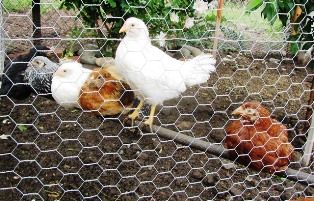
Chickens on an outside roost; inside, they roost on posts across the hen house
Roosting chickens are usually quiet. No doubt, you’ve heard the expression, “Going to bed with the chickens, rising with the rooster.” To say my hens were alarmed might be an understatement. They’d been roused from their slumber and cackled like there was no tomorrow. I realize there’s a bit of irony in the fact that our place is called the Henny Penny Farmette after Chicken Little’s story about the acorn falling on her head. This could have been the sky falling. They cackled like it was.
The deafening cackles agitated the neighbor’s pit bull, whose incessant barking got all the dogs in the hood howling. A fire engine shot by, sirens blaring. I took an aspirin, waited for my husband to return and the officers to leave.
Back in bed, who could sleep? I worried about when about when Code Enforcement might show up to cite the Beverly Hillbillies. Would the officers look over the fence and cite us as well? Code Enforcement aside, a gun-toter could hide behind our pile of porch lumber. We gotta get that porch finished.
But, like I said, it’s my husband’s birthday. He’s feeling romantic this week and not easily pushed. See my conundrum?
The Wait Is Over–Gifts in the Chickens’ Nesting Boxes
The White Leghorns are the first in my diverse, new flock to start laying eggs
Since March 7, the day I brought home eight baby chicks (The White Leghorns and the Silver Laced Wyandottes are two sets of sisters), I’ve been waiting for eggs. Today, I cleaned out the hen house and noticed that instead of three wooden eggs (I put them in the nesting boxes to encourage the hens to lay), there were five.
That means that either one of my White Leghorns laid two eggs or, more likely, each of them made a little deposit in the nesting box.
It’s a cheap thrill, I know, but I thought the egg-laying would start at 16 weeks but, in fact, it took 17 weeks and five days. Now, all that waiting seems almost silly. Hens lay when their DNA and biology tells them to. That’s all there is to it.
It remains to be seen if they will lay an egg each day or if their schedule will be more erratic. I’m not complaining since it’s nice to have fresh eggs any day I find them.
You Can’t Hurry a Chicken into Laying an Egg
I brought home my little flock of baby chicks on March 7. Yesterday marked 16 weeks or four months. That’s important because that’s when the feed store told me I could start expecting eggs from my White Leghorns. Not with mine. They are taking their own sweet time.
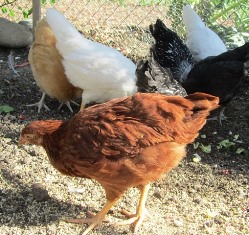
The Rhode Island Red is at the pullet stage, as is the rest of my flock of chickens
The Rhode Island Red can take between 20 and 26 weeks–or so I’ve been told–to start laying. Mine just wants to forage in the yard, follow me around, get in my face, and eat any extra blueberries that I didn’t consume with my morning yogurt and honey. I had a talk with her yesterday about how I’m expecting some eggs in return for all those blueberries.
My flock also includes a Buff Orpington, a Black Sex Link, an Ameraucana, and two Silver Laced Wyandottes, the latter is an old heritage breed can take up to 32 weeks to begin laying. So maybe around Halloween, I’ll find their first offerings.
In anticipation of the big egg-laying event, I’ve switched the chicken food to a crumble for laying hens. Tomorrow I will buy some oyster shell calcium for strong egg shells. I’ve also tucked smooth, wooden eggs into their nesting boxes with some soft straw, hoping to encourage the girls to get with it.

A chicken house with nesting boxes and perches
Their voices have now changed from the peep, peep, to cluck, cluck. But I’ve yet to hear that loud cackle that tells me an egg has been laid. Sometimes I’ll see one of some serious squatting and get excited. Okay, this is it. But so far, it isn’t.
So the watch goes on. You can’t hurry a chicken who isn’t ready to produce eggs. So in the meantime, I’ll be eating a lot more yogurt and berries for breakfast.
Stealing Away to Visit the County Fair
My daughter dropped by for a girl’s day out at the county fair. Summer chores are endless so taking a day off riddled me with guilt–and guilty pleasure.
We strolled under ancient, white bark sycamore trees that towered 50 to 100 feet above us. The first thing we saw as we entered the arched fair-grounds gate were goat pens. The cute little milking goats drew us over, but the odor of mounds of fresh horse manure turned us away. We kept on walking.
We moseyed over to see the sheep with their docked tails (apparently sheep like to chew on the tails of other sheep, so docking the tails eliminates pain and suffering and is more hygienic). We thought the baby goats were adorable. We marveled at how the pigs appeared so pink, healthy and robust. We couldn’t help but stare at the massive bellies and large bags of the dairy cows.
Embarking on the path to the exhibit halls, we relished how cool it was inside, a veritable respite from the heat. We strolled down aisles of quilts, art by high school students, and displays of jewelry. Then it was time to check out the jams. The entries of strawberry dominated the competition, but some included jam made with fig, plum, or rhubarb.
During the dessert competition, pies, brownies, and cakes beckoned us to peer into the glass display shelves. My daughter lamented that she wished they were for sale, reminding us it was time to eat.
We passed on the roasted corn on the cob and cotton candy, choosing simple tacos and Pennsylvania Dutch-style funnel cakes. I washed my meal down with the hibiscus-flavored drink sitting next to a dispenser of white horchata while my daughter stuck with water.
Before we left the exhibit halls and animals, I wanted to see the chickens. That competition must have happened on a different day, so I wandered over to the peacock pens next to the pigeons, finches, and parakeets. The peacocks were lovely but there were no peahens.
We checked out the bunny cages (I didn’t know there were so many kinds of rabbits) and decided against even looking at the reptiles (I tend to dream about them once I see them–and snake dreams aren’t usually pleasant).
All that walking and sensory stimuli wore me out. By the time we arrived home in the late afternoon, I needed a nap. I thought a day off was supposed to rejuvenate you. Instead, mine had done me in, but the trip to the fair gave me gobs of ideas for my cozy mystery series.
One Curious Chicken and a Five-Gallon Pot
Rhody, the friendliest, most communicative chicken I’ve ever owned is the smallest in my flock of little hens. Barely 16 weeks old and not yet laying eggs, she would be a teenager in human years, I suppose. And like a teenager, she is curious and appears to thrive on new experiences.
Yesterday, the Rhode Island Red’s curiosity got her into a hot spot, literally.
Rhody with the rest of the flock of nine chickens
The blood orange sun had nearly disappeared over the farmette’s western fence when I noticed a chicken missing from the flock. I was sitting outside trying to feel cool for it had been a searing hot day. As dusk set in, I noticed the chickens moving toward the hen house.
It didn’t take long to figure out that Rhody wasn’t among them. Panic set in as I recalled a couple of hawks circling the farmette earlier. I ran inside and woke my husband from his nap and the two of us set out on a search.
We covered all of our property and then ventured into the neighbor’s acre. We found no chicken feathers that might indicate a tussle with a hawk and my spirits should have been buoyed by that . . . but I imagined other terrible scenarios.
Fighting back tears, I followed my husband back through the gate to our farmette. Not about to give up the search, I retraced my steps to the garden. On the way, I kicked over an upside down black container that had held a five-gallon fruit tree.
And there stood Rhody. She remained frozen like she was as stunned to see me as I was to find her. She must have been under that container during the hottest hours of the day without water or food. She seemed weak, but not as bad off as I would have expected being trapped in 90-plus degree heat.
She managed to wobble back to the hen house on her own two legs. Eschewing the perch, she crouched down for the night in a straw-lined nesting box.
This morning, curious Rhody was the first out of the chicken house. As she made a beeline for the garden, I found myself remembering that old adage about how curiosity can kill a cat. In Rhody’s case, it almost cooked a chicken!
Building A Honeybee House
For my birthday this year, my husband surprised me with some practical beekeeping gifts and a promise to build an attractive bee house to hold our hives. In a plastic, five-gallon honey bucket, he’d placed a beekeeper’s suit, goatskin gloves, and a smoker.
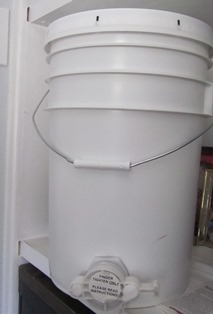
A honey bucket with a spigot makes it easy to drain honey into jars
This weekend, he made good on his promise. Although the temps hit 85 on Saturday and Sunday, he suited up in a lightweight beekeeper’s topper with protective netting over the face and got to work measuring, cutting, and securing the waterproofing material, hammering it in place.
With the waterproofing material attached to the roof and sides, he then covered the structure with old fence boards. But it wasn’t easy to mark the cut lines wearing gloves much less cutting the boards with the arm and table saws. He peeled the gloves off.
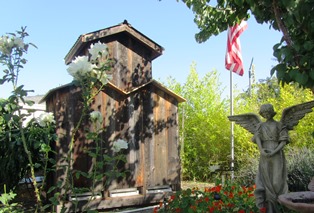
Beekeeper access is through the rear; the upper story holds a supply shelf; bee entrances are at the front bottom
Now, I know one thing about honeybees. Knocking at their door (say, with a hammer) will bring the guards out and they’ll sting . . . which they did.
My husband was on a mission and wasn’t about to let a bee sting stop him. He rubbed the spot with an ice cube, refused to take any Benadry®, and returned to work. But, not before donning some gloves.
But the gloves he put on weren’t beekeeping gloves. They were gardening gloves, good for deadheading roses but not much of a defense against venom-filled stingers.
So, for a little additional insurance against any more bee stings, we lit the smoker to calm the bees a bit. My husband was nearly finished working around the entrance to the hive when one of the honeybees apparently took notice of the fabric portion of the glove and stung right through it.
Even then, Carlos didn’t want to stop working. Only two metal roof sections remained to be cut, placed, and secured along with a shelf for the supplies. But it was sunset. The bees were going in for the night, and we were working in their flight path. We decided to call it a day, too.
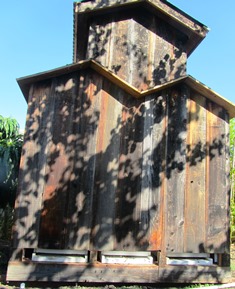
Bees need about six feet of unimpeded space straight in front of their hive entrance
The bee house roof will need to be finished before the rainy season starts in November. The good news is that the bees won’t bother Carlos if he stays in back of their house or on the roof. Activity at their front door sends an alarm through the entire colony that a predator is trying to get in. The honeybee defense is to go into attack mode, even if the “predator” in this case is the architect who designed and built their darling little house.
20 Interesting Facts about Honeybees
If your fruit trees, berries, and flowers are flourishing, you can be assured that bees have been busy in your garden. If you are a gardener who lives near a beekeeper, consider yourself really fortunate. Eighty percent of pollination is attributed to bees. Without these industrious little insects, Earth’s plant diversity would be in jeopardy. Here are some other interesting facts about honeybees (apis mellifera).
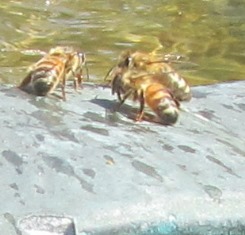
Worker honeybees drinking water on a hot day
WORKER HONEYBEES
1. The worker honeybees are sterile females. The workers keep the hive clean, serve as nursemaids to the babies, forage for food, scout for new locations, stand guard at the hive entrance, and care for the queen.
2. The lifespan of a worker bee is 6 to 8 weeks; the queen’s lifespan can stretch to 3 years.
3. In her short lifetime, an average worker bee will produce about 1 1/2 teaspoons of honey.
4. A honeybee will travel about six miles from its hive to forage on nectar- or pollen-rich plants.
5. Honeybees never sleep.
6. During one collection flight, a honeybee will visit between 50 and 100 flowers.
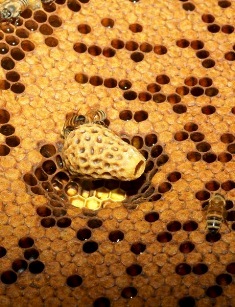
Queen cell that houses the honeybee queen who is fed royal jelly
THE QUEEN
7. A honeybee queen is made or created (as opposed to being born). Worker bees secrete royal jelly through the glands in their heads (hypopharynx and mandibular) to feed the larvae. Rich in vitamins and nutrients, the royal jelly may also contain a single protein known as royalactin and scientists believe this ingredient ensures the larva becomes a queen.
8. Newly emerged queens will fight to the death, leaving only one to rule the hive. The honeybee queen lays around 2,000 eggs. These become fully developed in 21 days.
9. The queen doesn’t leave the hive. Her job is to mate with the drones, produce eggs, and serve as matriarch of the colony.
THE DRONES
10. Drones are bigger than the worker bees but smaller than the queen and have rear-ends that are more blunted than round.
11. The drone’s sole purpose is to mate with the queen, which he does in the air. Drones die during mating.
12. Drones do not have stingers unlike the worker bees who have stingers with bee venom.
13. Drones are kicked out of the colony in the autumn when mating season in over because the honey reserves are needed to support the colony’s queen and workers through the winter. The drones are expendable since they don’t forage for food, make honeycomb or honey, care for the babies, clean the hive, or otherwise contribute to the colony.
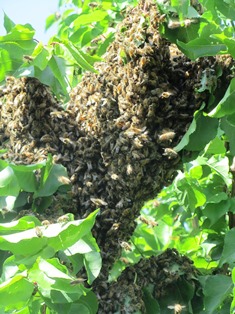
Swarms often land in trees; swarming is the method by which honeybees expand their colonies
THE COLONY
14. Honeybees communicate with each other through chemical signals. When there is a predator present, the worker bees release a pherome that communicates to her hive mates the need to attack.
15. The primary swarm (with the old queen) happens in spring and is a colony in transition. Swarming is the method by which the bees leave the hive en masse to establish a new colony. Swarming usually occurs during a two-week period in spring on warm days.
16. A swarm can include 10,000 bees but they are not in attack mode; they are preparing to move to a new home with their queen and are carrying the honey they need for the trip in their stomachs.
17. Honeybee colonies have been around for millions of years. There are fossils of honeybees in European deposits dating back 23 to 56 million years ago.
HONEY
18. Honeybees are the only insects that produce a product that humans eat. Honey is highly nutritious and has many health benefits.
19. Honey never goes bad; honey was found in King Tut’s tomb.
20. It takes more than 500 honeybees collecting pollen from 2 million flowers to make 1 pound of honey.