You are currently browsing the archives for the Wildlife category.
Blogroll
 Facebook
 Goodreads
 LinkedIn
 Meera Lester
 Twitter
SITE VISIT COUNTER


Archive for the 'Wildlife' Category
How My Real Life Informs My Art
Every story needs a setting, a world in which something happens. For my cozy mysteries, I didn’t set out to create a new world for my coterie of characters, I just appropriated details of the life I am living as a farmette dweller.
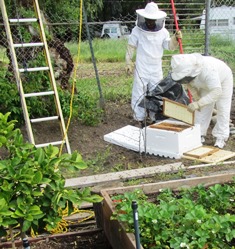
Spring beekeeping involves rescuing swarms, which can be quite dramatic
Daily chores on our Henny Penny Farmette provide plenty of fodder for my fictional stories. Our daily activities include chicken care, garden and orchard work, beekeeping, cooking and preservation of vegetables and fruits, renovating the antiquated farm house, fixing sheds, and building fences and retaining walls.
Stories need a sense of verisimilitude for readers to suspend disbelief and join the fictional journey. Drawing upon my real-life experiences, I can easily integrate my adventures in my books. And not only my activities, but also experiences of my architect husband who is ever-occupied with making our old house more liveable.
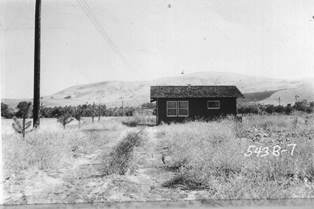
In this 1953 photo, our little house sat in a great, big field with not much around it; the dwelling faced Mount Diablo (still does) and the Delta and great central valley lie to the northeast
The tax assessor told me that our dwelling might have been a mining shack in the late 1940s (we live near Mt. Diablo and Lime Ridge where mining and rock quarrying were once important industries). We’ve also been told that our little house might have later served as a farm home (we live less than two miles from designated agricultural farmland). The structure desperately needed updating when we found it almost five years ago. But as settings go, the house and farmette work great.

Creating a pattern for the kitchen counter back splash
We have since used recycled and reclaimed materials, sale items at big box DIY stores, and gifts (like lumber, stone, and windows/doors) from friends who do demolition on estates. We’ve visited companies that sell granite and asked for permission to take broken stone from their dumpsters. Thus, we’ve created a lovely bathroom floor with found materials that we’ve cut and sanded.

Light from a crystal chandelier dances off the new granite counter, but the floors were not yet installed when this photo was taken
Of course, the exact details of our daily activities may not make their way into my stories, but versions of them sometimes do. At the very least, such activities inform my storytelling. I daresay the chickens and bees serve important roles in my mysteries. And each new day brings new adventures, from foxes showing up to skunks and raccoons raiding our fruit and nut trees.
Lately, a new chicken showed up on our property (a heritage chicken that had the ability to fly over my neighbor’s fence). She’s been staying here ever since. Wild turkeys often take a path through the property and once or twice a gorgeous stallion named Romeo and its owner ride by and say hello. Such events can add textural details to the setting of a story.
A Dog-Gone Good Day for Rain
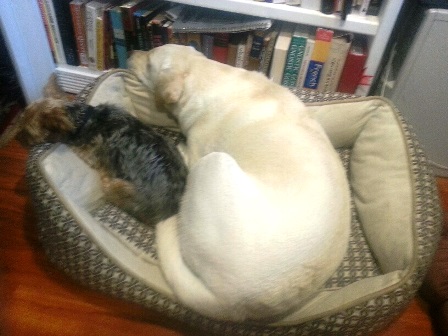
Any rainy day is a good day to nap, even if it is Halloween when there might be spooks roaming around
Happy Halloween from the Henny Penny Farmette. It’s raining at last!
The San Francisco Giants, by winning the World Series, must have created Mojo in the Pacific because the storm door has opened. It’s been raining outside my farmette window for a few hours. Could this spell an end to our extreme drought?
It’s been a quiet day for me working on my second book. The two dogs that I’m caring for have shown me the sweetest doggie affection with their wagging tails, smiles (yes, I think they smile), and lots of licks. They’ve won me, the reluctant dog-sitter, over.
We’ll have to say goodbye today though. Their family is enroute from Disneland and will be home in a couple of hours. So while the dogs and I started off on the wrong paw, overall I’d have to say it was a great adventure. I’m gonna miss them.
Honeybee Hive Pests Include Real Vampires
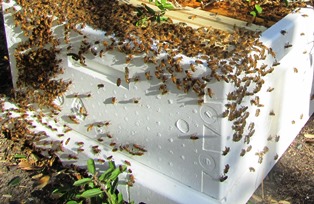
A super or hive box with ten frames
Every beekeeper wants to keep his or her hives healthy. Staying on top of your bee’s health means early detection and treatment of pests in the hive such as Varroa mites, trachea mites, hive beetles, and wax moths.
Varroa mites–these small reddish brown pests are akin to tiny vampires, feasting on your bees’ blood. Non-medicinal approaches to treating for these mites include introducing a screened bottom board. Mites fall through and cannot re-enter the hive to reattach to the bees. Also a powdered sugar dusting of your hives’ top bars can dislodge mites.
Tracheal mites–these pests are more difficult to detect. My beekeeper neighbor showed me infant baby bees with partial wings and said he believed it was the work of tracheal mites. To rid your hives of these pests, you’ll need to use menthol crystals and grease patties.
Hive beetles–if you see an insect with a hard, small black shell in corners and dark places within the hive, you may have hive beetles. They devour bee brood, honey, wax, and pollen. Treat the soil in front of the hive and inside the hive, you can try hive beetle traps or treat chemically. The infected honey will be rejected by the bees and should be considered unfit for human consumption as well.
Wax moths–these nasty little creatures can been seen in honeycomb and leave a silky trail over your hive’s hanging frames. If you see evidence that they’ve tunnel into the wood, know that you’ve had the infestation for a while. Wax moths will weaken a colony. Treat the infected hives with moth crystals formulated to eliminate wax moths in the hive.
Hives that are frequently checked their beekeepers stand the best chance for having healthy colonies of bees.
Help–There’s a Chicken on My Back
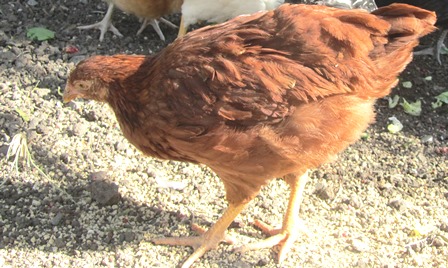
My as-yet-unnamed Rhode Island Red thinks she is my best friend
Collecting eggs, I bent over into the chicken house. Suddenly, a large chicken land on my back and start talking to me in her chicken language. I immediately knew it was my Rhode Island Red. She follows me everywhere.
It would have made a cute picture, but here’s the thing: you don’t want chickens tarrying too long in one place because they are famous for frequent and abundant droppings.
The Rhody is the most personable chicken in my flock and the one I handled the least when I cared for the flock of baby chicks in a tub in my kitchen. However, the chicken I handled the most from my tub of baby chicks was the yellow Buff Orpington, and today she’s difficult with the other hens and its also the first to have gone broody.
As I do chores around the farmette, the Rhody keeps me company. When I go inside to work in my office on my writing projects, she often hangs out under my office window, clucking or making an number of various chicken sounds. She also responds to my voice when I call out her. If I had it to do over again, I’d have a whole flock of Rhode Island Reds, just for the personality.
Big, Blonde Buff-O Goes on the Attack
The yellow-colored Buff Orpington hen seemed so cute when she was all down and a day old.
But six months have passed, the Buff-O has feathered out and gone broody. Today, she showed me a nasty-tempered, cranky hen, with ruffled feathers who will stop at nothing to hatch the clutch of eggs she’s sitting on.
The problem is that some of those eggs in the nesting box aren’t hers, and they’re all unfertilized since we have no rooster.
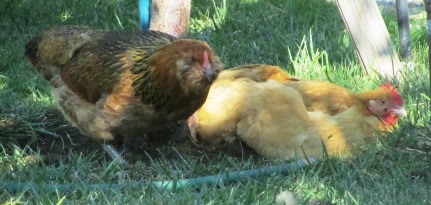
From left to right: Furry Face, the Ameracuana, and Buff-O, the Buff Orpington, when they used to sun themselves together
Buff-O has been sitting on the clutch of eggs for almost three weeks now, barely leaving to eat or drink. But today, she exited the hen house to take dirt bath–that’s how chickens clean themselves. Toss on the dirt, roll in it, then get up and shake like a dog, flinging the dirt in all directions as far as possible.
Before the fight started, all nine of my hens were foraging on our property, except for Buff-O and the shy Ameracauna with the furry face. The latter was in the chicken run, scratching the dirt, minding her own business.
I saw Buff-O walk over and lunge at Furry Face in attack mode. She used her beak to viciously peck Furry Face’s neck and her clawed toes to tear at the poor shy chicken’s back. She seemed more rooster than hen.
I ran for the hose and separated the two with a spray of water. Then, with both out of chicken run and into the yard, I gathered up all those unfertile, soon-to-be-rotten eggs that Buff-O has been trying in vain to hatch, and headed toward the garbage can.
But apparently, tossing those eggs changed nothing. Buff-O is back in the hen house on the nest–albeit, a different nesting box than before. But the straw in the original nesting box is still warm. It’s being occupied by Furry Face. Go figure!
Hypoallergenic Label for Dogs Might Be Misleading

Choosing a short-haired pet may not reduced pet allergy-triggered rhinitis
Finding a dog that won’t cause wheezing and sneezing sounds like the perfect solution for families with allergies. But apparently the notion that some breeds–like poodles, labradoodles, terriers, shi tzus, or short- haired dogs–are hypoallergenic isn’t quite the case.
Allergic rhinitis is a common malady that affects 600 million people worldwide (200 million have asthma alongside the rhinitis). Pet allergies bear a significant burden as a common trigger for allergic rhinitis. See http://www.ncbi.nlm.nih.gov/pubmed/20031002
In an article from 2013 in the San Francisco Chronicle, author Kathryn Roethel cited a study by scientists in Detroit, who conducted research involving 173 single-dog homes. See, http://www.kathrynroethel.com/mythbusters/hypoallergenic-dogs-not-allergy-free-study-says
The researchers vacuumed floors of bedrooms in the Detroit area homes. Their goal was to find samples of a protein in pet saliva that caused human allergies to dogs, namely, canis familiaris 1. That allergen was found in 163 of the 173 homes the researchers tested. And dogs (labeled hypoallergenic), according to Roethel “averaged the same amount of the protein as non hypoallergenic dogs.”
Pet owners could reduce the amount of the allergen canis familiaris 1 by having tile and wood floors (which showed slightly less of the allergen in the study) than other floor materials such as carpet.
Also, dog owners could limit levels of the allergen by limiting the rooms that their dog was allowed in.
Keeping dogs outside did not eliminate the presence of canis familiaris 1, although indoor levels could be reduced.
An different study by the same research team indicated the presence of “canis familiaris 1 in approximately half of homes without dogs,” noted author Roethel, “possibly because dogs had lived there in the past.” To read the study, see http://1.usa.gov/1b7F5B4.
The solution is not to get rid of the family dog, but to find ways to reduce exposure to the allergen, canis familiaris 1. Talk with your allergist or family physician about options. And if you are thinking about becoming a dog owner, be aware that the hypoallergenic label might have little to no relevance.
A Broody Hen, A Clutch of Eggs, and No Rooster
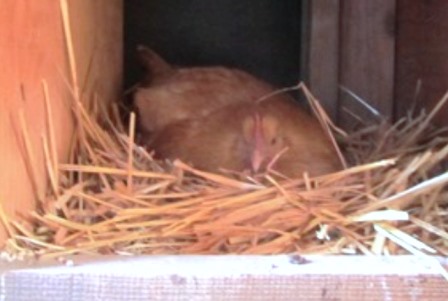
A broody chicken, like my Buff Orpington shown here, may peck you if you try to disturb her
My little yellow Buff Orpington {as yet unnamed) has gone broody. I didn’t know this behavior could happen so early in her young life. At 20 weeks, she’s only just started laying eggs. Now all she wants to do is sit on them.
Like an expectant mother, she contentedly sits, apparently anticipating the arrival of her chicklets (in 21 days). I don’t have the heart to tell her that she needed a rendezvous with a rooster to get eggs that will hatch. And, in case she hasn’t noticed, we don’t have a rooster.
She’s become a fixture on the nesting box, forcing the other chickens to lay their eggs in the other two. Buff O. sits on the eggs (who knows how many are under her) with a glazed look in her eyes. If I go near her nesting box, she puffs up and ruffles her feathers like an attack chicken.
She must leave the nest to eat, drink, and poop . . . . but I haven’t witnessed it, so I have put containers of food and water near the nest. I don’t want her losing weight or getting sick during her sit-in.
At first, sensing that she was behaving strangely and fearful that something be wrong with her, I began searching the Internet. Apparently some breeds like Silkies, and Cochins have a tendency to go broody. And, they can go broody more than once during the year. See, http://blog.mypetchicken.com/2012/02/01/what-is-a-broody-hen.
Apparently, dictated by their biology, laying hens decide to sit on a clutch of eggs, even rolling other chickens’ eggs under them if there aren’t enough. The laying hen will rotate her body to redirect heat evenly over the eggs or pluck out her own chest feathers to create more warmth and moisture for the eggs. In the case of my hen, I’m trying to imagine a bare-chested chicken sitting on a clutch of eggs that will never hatch.
Broody hens will even talk to the eggs (and the little chicks growing inside). It’s mommy business they are attending to. However, once a hen has gone broody, she will stop laying. And as for the mommy business, I have no idea how my Buff Orpington will figure out that those eggs she’s so carefully guarding . . . well, they’re just eggs.
If It’s Good Enough for Bill Gates, I Might Try It, Too
On Sunday mornings on our farmette, we almost always have potatoes, assorted cheeses and fresh fruit, along with homemade bread, honey, and a jar of apricot or strawberry jam that I’ve put up during jam season. But organic eggs from my free-range heritage chickens takes center stage, scrambled or poached (my favorite, a la Jacques Pépin and Julia Child), or cooked in an omelet with fresh herbs.
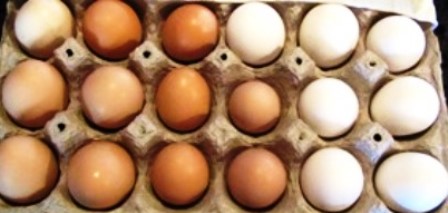
Assortment of organic eggs from free-ranging,heritage laying hens
People who can’t eat poached, scrambled, or omelet eggs because of cholesterol concerns or egg allergies often make do without eggs or indulge their omelet craving with egg substitutes. But what about egg-free cookie dough or mayonnaise?
Enter Eco-food innovator, Hampton Creek Foods. The company’s biochemical scientists at work at the three-year-old, San Francisco-based company have come up with an egg substitute that is plant-based. It has already found a perfect plant-based recipe for egg-free mayonnaise and cookie dough.
With its egg substitute, Beyond Eggs, and other products, the company seeks to crack open an industry that produces 1.1 trillion eggs annually.
According to Katie Fehrenbacher, writing last year for Gigaom, Hampton Creek Foods CEO Josh Tetrik says “the food industry is broken.” See, http://gigaom.com/2013/09/11/hampton-creek-now-selling-plant-based-eggs-at-whole-foods-in-california/
Hampton Creek touts its plant-based, egg-free formulas as cheaper, healthier, and more humane. With its emphasis on food technology, Hampton Creek has attracted interest and funding from Silicon Valley venture capitalists and the world’s super-wealthy billionaire Bill Gates and Li Ka-shing, Asia’s richest man.
Earlier this year, Forbes writer Ryan Mac discussed Hampton Creek’s food technology venture that has attracted the interest of Yahoo co-founder Jerry Wang and Li Ka-shing. See, http://www.forbes.com/sites/ryanmac/2014/02/17/egg-replacing-startup-hampton-creek-foods-raises-23-million-from-asias-richest-man-and-yahoo-cofounder-jerry-yang/
In California, foodies can find Hampton Creek’s Beyond Eggs at Whole Foods stores. Those who love the real thing can buy eggs labeled as organic, produced by pastured free-range flocks.
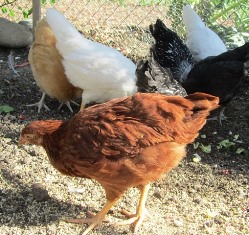
A Rhode Island Red forages with a Buff Orpington, two White Leghorns, a Black Sex Link, and two Silver-laced Wyandottes
According to tests conducted by Mother Earth News,the eggs from free-range pastured chickens have more beta carotine, vitamin A, vitamin E, and Omega-3 fatty acids with less cholesterol and less saturated fat than most store-bought eggs from chickens that weren’t pastured. See, http://www.motherearthnews.com/real-food/free-range-eggs-zmaz07onzgoe.aspx#axzz3CB01GPlj
Sunday mornings on the farmette wouldn’t be the same without fresh eggs from the hen house, but if Bill Gates likes Hampton Creek Foods’ products, I might just give them a try. Still, I’m having a hard time imagining how the taste of an egg substitute from a yellow-pea and canola concoction could rival an organic egg.
The Fox, the Fence, and an Angry Bird
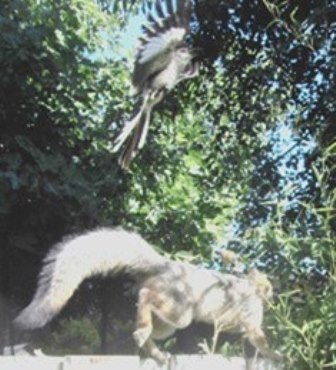
Fox on the run with a mockingbird on attack
The Henny Penny Farmette name was inspired by the English folktale featuring Chicken Little, Lucy Goosey, Foxy Loxey, and the gang. And now, it’s beginning to seem more like we’re living that folktale on our Henny Penny Farmette with the ongoing shenanigans of the foxes, wild birds, and chickens.
The foxes showed up mid-morning, no doubt to see if the chickens were out. The presence of humans frightened the four-legged gray foxes and the two of them leaped to the fence to make a quick-like-a-fox getaway.
Feeling thankful that I hadn’t yet released the chickens from the hen house, I grabbed the camera and took aim at the fox on the fence. I missed the first fox but just as I snapped the shot of the second fox on the run, a seemingly angry mockingbird dove down to thwart the fox from getting any closer to her nest . . . or for some other reason that remains obscure.
It’s night now and the chickens are all locked in the hen house on the roost. I hope the foxes stay away because when they come around the chickens raise such a ruckus, no one can get any sleep. And it’s been a very long day on the farmette that has followed a series of long days involving those wild foxes looking for a chicken dinner.
They’re Ba-a-c-k!
The sound of the chickens squawking propelled me upright in bed. The sun wasn’t up yet but there was a ruckus going on in the chicken house. And it didn’t sound pretty.
I leaped from bed, staggered to the window, pulled up the blind, and looked out.
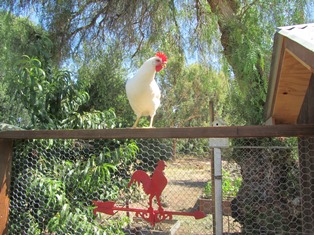
I know she’s thinking, “I’m not coming down until that fox is gone.”
The foxes had returned. One stood on its hind legs, pawing at the double layer of poultry wire screwed over the open chicken window.
I yelled, “Get out of there!” hoping the fox would leave . . . but it didn’t. It just made the chickens squawk louder.

Throwing on my robe, I raced to the patio where my red, rubber (indestructible) clogs waited for my feet to slide in. Grabbing the broom and a two-by-four, I raced to the chicken house, yelling all the way.
This time the fox paid attention, but showed no interest in retreating. I waved the broom and pounded my board against the metal garbage can (in which I keep the 25-pound bags of chicken feed). The noise did the trick. Off went the fox to join the other two.
The three disappeared into the wooded acre of land behind our property. Finally, my chickens settled down. I let them out for the day. One deposited her egg–not in the nesting box–but on the ground, as if too freaked out to go back inside the hen house. Well, can you blame her?