You are currently browsing the archives for the Wildlife category.
Blogroll
 Facebook
 Goodreads
 LinkedIn
 Meera Lester
 Twitter
SITE VISIT COUNTER


Archive for the 'Wildlife' Category
Is He or Isn’t He a Brown-headed Nuthatch?
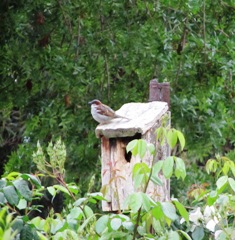
Brown-headed Nuthatch visiting our farmette during the summer
I’ve been checking out the photos of birds I’ve taken since moving to the Henny Penny Farmette. I’ve been able to identify most of them, but one took a while for me to figure out. Like other birds that come by for a visit, he perched for a spell atop the rough-hewn birdhouse on the back fence. I think he is a brown-headed nuthatch (sitta pusilla), although I am not completely convinced I’m right. Half the fun of being a bird watcher is figuring out what species you have spotted.
Still, the bird has the right markings–the brown cap down to the eye, white nape spot, white throat and underparts, and some gray on its back. With beady eyes, broad shoulders, and a short neck, this little bird seems to best fit the description of the brown-headed nuthatch although that species likes the pine forests of the southern United States and travels in flocks. This fellow showed up alone in my Northern California garden.
I got out my Audubon Society bird guidebook and the Song and Garden Birds of North America, a National Geographic book, to help me identify the nuthatch and some of our other feathered friends. So far, we’ve had visits by sparrows, finches, scrub jays, a pair of Western bluebirds, mourning doves, wrens, a barn owl, lots of hawks and crows, and hummingbirds.
We’ve put up birdhouses, some with rough bark exteriors, that seem to attract certain types of birds. Other birdhouses are smooth surfaced. The bluebirds were checking out one of those today. Spring will come . . . eventually, but even before trees start to break bud, the birds will be scouting nesting sites. I’m hoping the brown-headed nuthatch will return with a mate and stay around for a while.
Food for Bee Babies
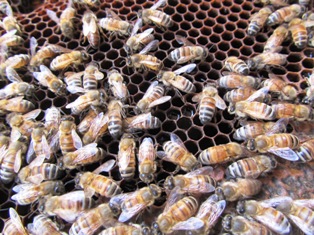
Beleaguered honeybees can have a difficult time making it through winter
The bee suit I’ve worn this morning smells like smoke from the smoker. My neighbor opened his hives today to check on the status of the bees and I was happy to help. I learn something new every time I work with him. We’ve had freezing nights with the temps hovering below 30 degrees Fahrenheit, not good for bees.
Upon opening the first hive, we could see the bees were docile. After all, it is winter. The bees must work hard to keep heat in the hive and they aren’t expecting us to be intruding into their world. In fact, my neighbor didn’t bother with putting on either the beekeeper suit or the elbow-length leather gloves. He loves his bees and has no fear of being stung.
Our work today was putting into each super a patty of brood building food (mainly high fructose corn syrup, soy flour, and other nutrients) as a substitute for pollen, especially necessary to feeding bees. Beekeepers often feed their bees in late winter or early spring since there is little pollen to be scavenged from flowers. Flower and blossom pollen comes later in the spring.

Queen bee house on honeycomb–photo courtesy of Carlos Carvajal
We must do all we can to help the beleaguered little honeybees. We have even covered their hives with blankets, reducing the necessary labor of the worker bees in keeping the hive humming and warm.
So I don’t mind smelling a little like smoke for a while to help the bees, and I’m hoping the bees won’t mind that I took one little frame of honey from their hive to my kitchen.
A Scrub Jay to Keep Me Company
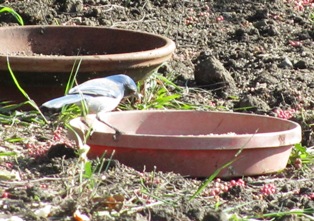
A Western Scrub Jay perhaps wonders when the birdseed will be replenished
A Western scrub jay darts into the yard, drops to the ground, and investigates the pottery saucer then pecks at small red berries that have fallen from the giant pepper tree along the back fence. The jay visits almost daily, but the rest of the wildlife seems to have taken cover, maybe because it’s so cold out.
The citrus trees have been covered for a few days with blankets and thick sheeting of black plastic since freezing temperatures are forecast for several days. It’s darn chilly and if the rain comes that is also forecast, we could see a dusting of snow around the top of Mount Diablo.
In early December, I walked around the farmette in shirt sleeves, but today it’s taken three layers of sweaters, two pairs of socks, and long johns under jeans to stay warm. You’d think I was dressing for a visit to Siberia.
This will be a short break. Indoors, I’m working on my own book and editing another one for a friend. My exercise period won’t be long, but at least a walk around the farmette gets blood flowing to my brain, exposes me to the sun for an all important daily dose of vitamin D, and allows me to breathe fresh air. So even if it is only the jay keeping me company, the pleasure is all mine.
Missing My Chickens
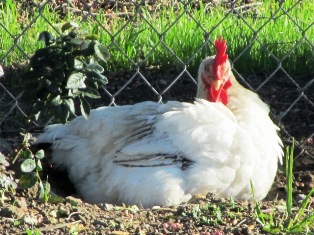
Tighty Whitey
My next door neighbor welcomed us to the neighborhood when we bought the Henny Penny Farmette. He gave us produce from his garden, honey from his hives, eggs, and even the chickens that laid them. We didn’t even have a chicken house back then.
That didn’t stop us. It was summer, I was married to an architect/builder, and we put “build a chicken house” on our list of things to do.
It took about a week to build out the chicken house. The best time to transport chickens are at night when they are calm. You go into their old roost after dark and carry them to their new dwelling.That way, they awaken at dawn in their new home, and the move is a fait accompli.
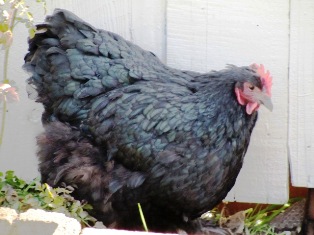
Mystery, black Cochin hen
After the six laying hens moved in, I named them. The white one seemed especially flighty so she became flighty Tighty Whitey. There were two brown hens, Click and Clack; two Mediterranean hens, Henrietta and Heloise; and Mystery, the large black Cochin, who wouldn’t lay many eggs but loves to sit on them.
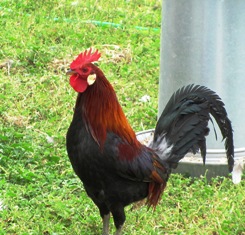
Houdini, the escape artist
Since my neighbor believes that every hen house needs a rooster, he brought over a cute little whipper snapper that I named Houdini. What Houdini lacked in height and weight (he was after all a Bantam), he made up for in attitude.
Carlos outdid himself building that chicken house. He insulated it, tiled the floor, put in nesting boxes all along one wall (with little windows that could be opened so you could reach in to gather eggs), and a red thermal light for heat.
One day, inspectors from the city came out to look for standing water before mosquito season began and spotted the spiffy new chicken house. One fellow joked, “If those chickens don’t like it, call me. I’m looking for a new place.”
I grew attached to the chickens; so much so that when I lost two because of prolapsed cloaca, I mourned them as if family members had passed. Then last year, each time I cleaned the chicken house I suffered an asthma attack. This occurred in spite of wearing a mask the entire time I cleaned it. The chickens needed a clean house, but I could no longer be the cleaning lady.
I could not find takers for that job, so with a heavy heart I decided to give my chickens to a Lebanese lady. She wanted the chickens and had family members who would help her take good care of the brood. All the chickens except Mystery moved to the lady’s chicken house. Mystery moved back into the coop next door.
I miss the contented clucking of the chickens as they scratched their way around my yard. I miss Houdini’s gravely cockle-doodle-doo that awakened me before dawn. And I miss the fresh eggs that I would happily gather each morning from the splendid chicken house that Carlos built.
I’m fortunate that my neighbor kindly supplies me with organic eggs from his chickens. When I really get to missing the chickens, I popped over the fence to visit Mystery. Maybe she misses me, too. When I call her name she still answers.
Lately, I’ve been thinking about building a new chicken house with room for one or two chickens. I’d like to be able to move it around the yard on wheels. It would have to be tall enough to contain a roost and it would have to accommodate a nesting box or two, and include a wired section like a big box that could be detached. The whole thing wouldn’t need much cleaning. So, now I I’m trying to find the right time to broach the subject with my architect in residence.
Beekeepers: Take Note of Your Local Regulations
Hived honeybees at work
Backyard beekeeping has become a hot hobby . . . and it has come at an important juncture in the history of our planet. For several years, honeybee populations have been dwindling and bees mysteriously disappearing in Europe and America. This is worrisome since the bees are necessary for pollination of crops.
Perhaps you live in a city or town that supports beekeeping and has written that support into the municipal code or state law. Count yourself lucky to have all those little honeybees to pollinate your garden–even if you aren’t the beekeeper. But if you love honey, like I love honey you’ll want your own hive.
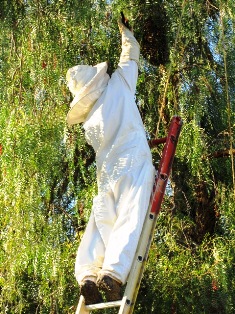
Rescuing a swarm; swarming is how honeybees increase their numbers
Before you go shopping for your beekeeper suit, check out your town’s municipal code and zoning regulations that cover the keeping of bees. Also, find out what state regulations might apply. Your town might not even permit beekeeping.
California law requires beekeepers to notify their counties. Having the law on the books, however, doesn’t necessarily mean the law is rigorously enforced. Lack of funding for oversight and enforcement makes it difficult to ensure the community’s beekeepers are compliant.
You might have to spend a little time trying to decipher the language in your municipality’s documents. Cities in the San Francisco Bay Area, have ordinances and regulations governing beekeeping that differ as widely as the language (contained in their documents) used to characterize bees. Bees as livestock . . . or exotic animals. Really?

Bees seal their honey in a wax honeycomb on a frame that fits into a super
Foster City and Fremont, both south of San Francisco, but on opposite sides of the bay, ban beekeeping. Further south, the cities of Palo Alto and San Jose require permits. So do some cities north of San Francisco, including San Rafael, Sausalito, Fairfax, and Tiburon. In Concord, it is unlawful to keep hives or maintain an apiary in the city, except under certain conditions. No hive within 25 feet of the property line and a sign at the front of the property advising of the presence of bees.
If you are a honey loving, aspiring beekeeper/gardener, I hope you are in one of those towns across America that recognizes the value of these little pollenizers. The populations of these beleaguered, little creatures are dwindling as if they were under siege. When your city/county/state supports your efforts (with the honeybees, of course), everyone wins. Best of all the honeybees and the planet wins. Imagine having to pollinate the gardens and fields of the world by hand. Now that’s a sobering thought.
The Inherent Gifts of Observation
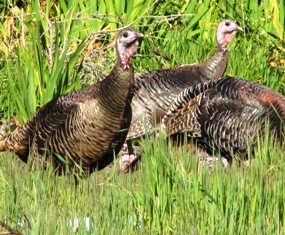
Wild turkeys on the move
through a back field
I saw some wild turkeys today strolling through the acre behind the farmette. If I hadn’t noticed them, I wouldn’t have captured them on film. They disappeared as quickly as they showed up. You have to pay attention for the moment is soon lost.
Some people never lose that childlike wonder of noticing everything in their environment. My grandfather was like that–a veritable treasure trove of information based on the observations of his world. An attitude of gratitude seems to come easily to such individuals, as if noticing and feeling thankful are linked.
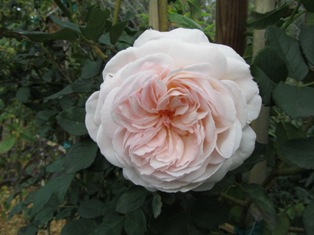
Shropshire Lad rose, pure perfection
in symmetry and scent
The Buddhist practice of mindfulness suggests that kind of noticing. For example, if you spot a flower while out walking (perhaps it even grows through a crack in the sidewalk), you might bend down to examine the flower. Does it offer a fragrance, beauty in its perfect symmetry, a ladybug on it’s stem, delicate leaf, or a gentle sway in the breeze as if it is dancing? These are the gifts the flower offers, the gifts it holds for you when you take the time to notice.
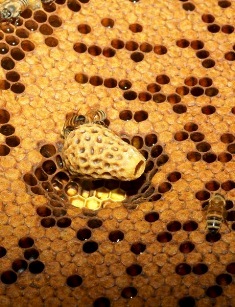
The honeybee queen’s “house”
I like working with the bees and seeing up close their world within the hive. I had never seen a “queen house.” When I did for the first time I felt astonishment at how perfectly functional it was. Honeybees create comb to seal in the honey–their food (and ours)–and these honeycombs and queen houses are functional, perfectly formed, and beautiful to gaze upon.
For my grandfather (and also in my own experience) observing nature’s glory conjures feelings of appreciation for so many blessings–the ability to see, hear, feel, touch, think, and sense what is present, what co-exists around us. This renders the perspective that we humans are mere specks in cosmic creation.
Our lives are richer when we appreciate what we have and take time to notice how richly adorned our lives are.
The Seductive Taste and Smell of Honey
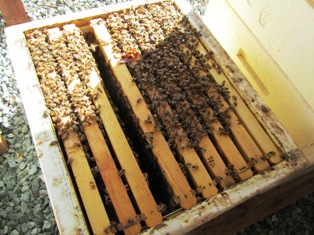
Super or hive with one of the ten frames removed
The sweet, seductive scent of honey permeates the rear of my property where the honeybee traffic has picked up now that we have had a few warm days. My neighbor Peter told me on Saturday that we would open the hives today. I enjoy helping him with bees, and my organic yogurt wouldn’t taste the same without that sweet honey drizzled on top.
Peter says it’s coming on winter now and the bees need food. Sources of pollen diminish during fall and winter. Our inspection will determine whether or not the bees and their hives are in good shape. Most likely, if there is honey, we won’t harvest it but rather leave it for the bees. Still . . . if there’s an abundance, we might take a frame or two.
When he was just a boy, Peter received his training as a beekeeper from his father. His father’s honeybees kept their Lebanese village supplied with honey. Our purpose in opening the hives today is to inspect the physical structures of the hives for mold, mites, ants, or any foul smell that might suggest a problem.
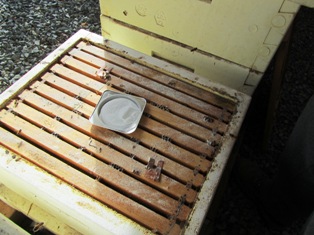
Tin of Apiguard for Varroa mite; also
medication in powdered sugar and hanging strips
We last medicated the bees during the first week of October. This morning, the bees were so docile, Peter didn’t even suit up. But I did. Even so, the last time I put on the head-to-toe bee suit and the elbow length leather gloves, I still got stung as I was removing the suit.
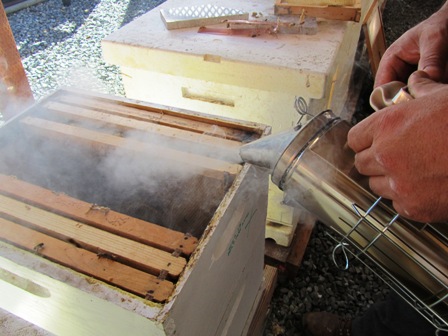
Smoking the bees to calm them
At approximately 9:30 a.m. , we started to open the hives, smoking each one, in turn and closely checking each frame. The hives all looked healthy and robust. We removed spent containers of Apigard and the hanging sticks of antibiotic.
After inspecting each frame in each hive, we re-medicated the bees to ward off mites and anything that might attack or weaken the immune systems of the bees. The goal is to keep them healthy and strong so that the honeybees survive with their babies through the winter to swarm in the spring (swarms are the way the bees expand their populations).
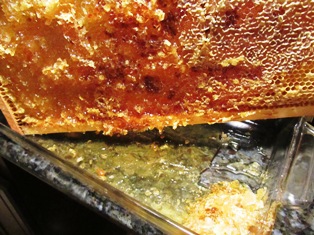
Golden honey draining from a frame
into a glass dish
The last three hives were particularly strong. The bees were busily working. Each super (styrofoam box or hive that holds ten frames) was heavy. We reduced the sizes of the hives to two supers instead of a stack of three on top of each other. Smaller hives during the winter means less work for the bees to stay warm and make babies.
Peter handed me three frames of honey to take to my kitchen. He also took a frame or two. Tomorrow, I’ll make a honey cake . . . if I can stop myself from constantly sampling the gorgeous colored, sweet tasting honey that slowly drips from the frames into large glass dishes in my kitchen.
Serve Up Seeds for Furry and Feathered Creatures
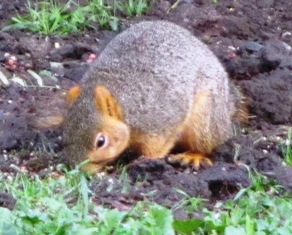
A squirrel forages for food
Squirrels can contort their bodies into bizarre and exotic positions just to get at the seeds in a bird feeder, as any wildlife watcher can tell you. But they aren’t crazy about all birdseed. Safflower is a good example of a seed loved by birds but not squirrels. The squirrels will forgo a whole feeder of that seed in order to dine on sunflower hearts that is also a favorite of chickadees, finches, and woodpeckers. Pesky squirrels will also paw through a bird feeder to eat other seeds mixed into a commercial wild bird feed but still pass on eating the safflower if it is present.
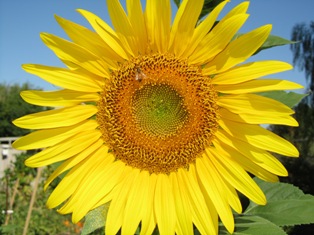
A giant sunflower blooms in summer;
by autumn the center head is filled with seed
Since both squirrels and many species of wild birds love sunflower seeds, we grow several types throughout the summer. When fall approaches, we place the dried heads of the sunflowers in an area away from a bird feeder to attract the squirrels and hopefully limit their foraging of food intended for the feathered wildlife. Sometimes it works. However, mourning doves are ground feeders and so are quail. We’ve found the squirrels and the birds foraging together for sunflower seeds.

A squirrel and mourning dove share a meal
The finches enjoy the black Nyger (or thistle) seeds so we keep one feeder of that seed just for them. We love the splashes of yellow (the coloring of their breasts) as they flit around and perch on the feeder to devour their favorite meal. But other birds with small bills like the California quail, pine siskins, towhees, dark-eyed juncos, song sparrows, and purple finches also are attracted by Nyger seeds and will dine often if the feeders are kept filled.
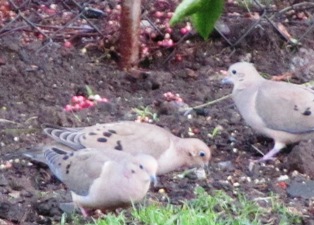
Mourning doves scratching for seeds
Squirrels and some types of birds particularly enjoy pumpkin seeds and peanuts, so we also put those out when the weather becomes bleak and we’re pretty certain that the wildlife around us isn’t finding much food. During those periods, we also hang suet for the birds, especially those that hang around for the winter but don’t have a lot of food choices such as crows, robins, and the American goldfinches.
When you ensure adequate food supply for the furry and feathered creatures in your backyard, you will be rewarded with many entertaining and heart-warming images. Keep your camera handy for capturing squirrel contortions or surprising pictures of who dines with whom.
Lots of Peppers and Sunflowers Hanging Around
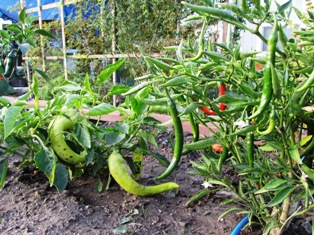
Peppers for my Mexican and Caribbean cooking
My pepper plants are still producing. It’s a week before Thanksgiving and by this time last year I had harvested all the warm season crops like the peppers. But the plants still have many peppers hanging and are still blooming.
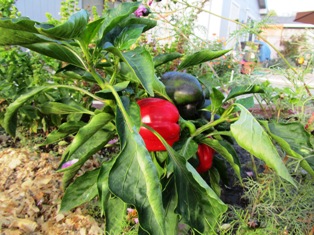
Sweet red and green bell peppers
I even have a tomato plant that’s got blooms on it. Of course, most old timer gardeners will tell you that tomatoes won’t set fruit if night-time temperatures aren’t 55 degrees Fahrenheit or higher. So I’ll wait for another week or two to figure out whether or not to pull out the tomato and harvest the peppers. I can use the sweet bells in my Thanksgiving dinner prep.
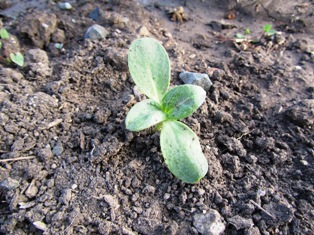
A giant sunflower starts as a small seedling
Yesterday, I laid out on a small stone floor a giant sunflower head that had already dried. The birds, and especially the squirrels, love the seeds. The squirrels practically replant them for me all over the property. The giant sunflower heads laden with seed are my gifts to the wildlife each autumn.
There are sunflowers and then there are the giants that stand seven or eight feet tall with heads the size of dinner plates. The stalks are as thick as the diameter of a coffee mug. It usually takes me a few hours of working with a pick axe to dig out all the stalks and compost them.
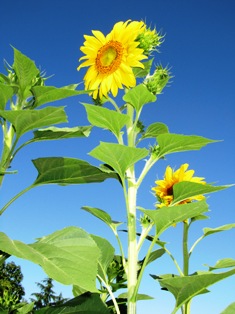
Picture postcard-perfect giant sunflowers
I save the seeds from the giants so I can let them dry over the winter and plant again the next year. I’m just guessing but I’ll bet from all the seed heads I’ve saved, I’ve got thousands of seeds. Maybe I’ll package up 50 or so to a bag and give them away at Christmas or sell them at the farmer’s market when it starts up again next year. For now, I’ve got my sights set on making some pepper relish for Christmas season gift baskets of food.
Backyard Bird Watching Soothes the Spirit

Finches dining on small black seeds known as Niger seed
Back in my old neighborhood I spent many happy hours watching the birds that flew into the massive pines behind my San Jose home. Then when I moved to the Miami area, I felt thrilled to spot a long-legged, white egret, a small but determined sandpiper, or a bald eagle or two visiting my home on the lake. The visits of those exquisite creatures were always brief and all too soon they would fly back to their nests in the brush or tall pines of the Florida Everglades, only a mile or two away. Now here on the Henny Penny Farmette, I am serenaded every morning by songbirds, often sweet little yellow finches feeding at the feeder five feet above the fence at the back of the property.
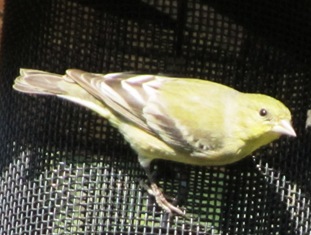
Closeup of a wild finch, bright eyed and curious
If you feed them, they will come. Finches love the black nyger seed. Our local feed store sells the seed in bulk and also in white mesh sacks with tiny holes perfect for finch beaks, which are quite small. Of course, some seeds will drop to the ground and, in my experience, easily sprouts and grows into a tall, skinny plant with a blue bloom. I’ve heard that you can sterilize birdseed so it would not root and grow if you toast the seeds for a short time in the oven on high heat. But be careful not to burn them. Not even birds like burnt food.
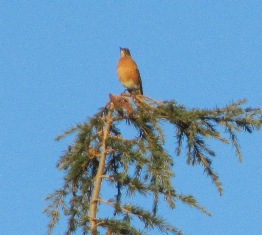
A robin surveys the world from the top of a tall pine
While making coffee this morning, I peered out the kitchen widow to see a beautiful bird with a rust colored breast perched atop the fifty foot pine. I believe it was a robin. Grabbing my camera, I got off a couple of shots before the bird took flight. I’m pretty sure I haven’t seen the last of that bird. Rain is coming again in a few days and robins love to hop around searching for worms. So regardless of what neighborhood I’m living in, I create habitat and put out food for the wild birds. It welcomes them and their presence nurtures my spirit.