You are currently browsing the archives for the Wildlife category.
Blogroll
 Facebook
 Goodreads
 LinkedIn
 Meera Lester
 Twitter
SITE VISIT COUNTER


Archive for the 'Wildlife' Category
Beekeepers File Suit to Ban Two Pesticides
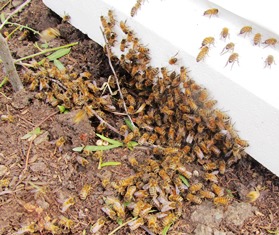
Honeybees at the base of a hive
Neonicotinoid pesticides pose a high risk to honeybees, a belief that has beekeepers aligned with environmentalists and scientists and is the basis of a lawsuit filed against the Environmental Protection Agency.
According to the EPA’s website, several European countries have suspended or banned the use of neonicotinoids (commonly referred to as neo-nics) for causing acute poisoning of honeybees. However, the EPA denied the request posed in a legal petition by environmental organizations and beekeepers in 2012 here in America to ban clothianidin, an insecticide classified as a neonicotinoid.
Recently, the Center for Food Safety, on behalf of commercial beekeepers and environmental organizations, filed suit against the EPA seeking to force the EPA to suspend the use of the insecticides clothianidin and thiamethoxam. Both insecticides are are neonicotinoids, a class of chemicals that harm the nervous system of bees.
Healthy bees are vital for the pollination of California’s almond crop (the state produces roughly 80 percent of the world’s almonds) but also bees are necessary for the pollination of roughly 30 percent of other crops in the United States.
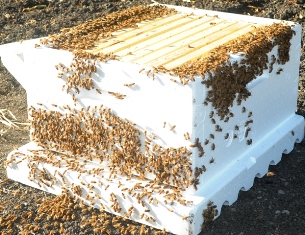
A new hive of healthy honeybees
When the almond orchards of California need honeybees for pollination, they turn to the commercial beekeepers, many in the Midwest. It is estimated that more than half of the nation’s honeybees are shipped in their hives here for the almond blooming season–possibly the nation’s largest pollination event. This year, there was a shortage of bees.
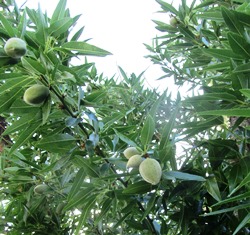
Almonds form abundantly on well-pollinated trees such as this one on the Henny Penny Farmette
With higher than usual die-offs of bees and colony collapse disorder (in which, bees disappear or die) on the rise, beekeepers and scientists have long suspected that the chemicals in certain pesticides play a role. Exposure to chemical residue in nectar, pollen, and dust (from treated seeds) not only hurt the honeybees, but some say also affect other beneficial insects.
The EPA states on its Website <http://www.epa.gov/opp00001/about/factsheets/protectbees_fs.html> that it is working toward pollinator protection on several fronts, including through regulatory, voluntary, and research programs.
Although the EPA is re-evaluating the use of neo-nics, the agency’s re-evaluation process will not be completed anytime soon–it can take years. That could be bad news for the nation’s beekeepers and California’s almond growers.
Déjà Vu
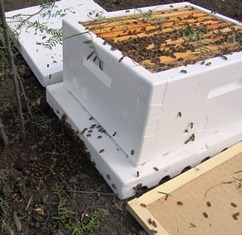
Pieces of the pepper tree landed with the bees on their hive after the swarm was captured
I heard the whine even before I looked up and saw the honeybees coalescing into a swarm. I was on my knees at the back fence of the farmette helping my husband Carlos remove weeds from under the pepper tree. I dashed into the kitchen to retrieve a stainless steel pan and, using the gardening trowel still in my hand, began banging on the pan’s bottom.
My beekeeper neighbor swears that the banging noise disorients the bees so they will take refuge in a nearby tree instead of flying miles away. This was the second swarm in as many weeks on our farmette.
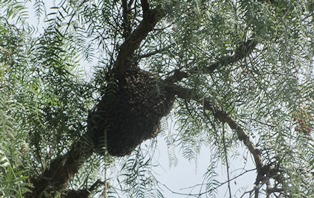
The honeybees are swarming in the pepper tree around their queen
The swarm from my neighbor’s hive alighted in the tall pepper tree at our back fence line. Just a week or so ago, a swarm landed in our almond tree. Dressed in his beekeeper’s suit and gloves, my neighbor arrived carrying a black garbage bag fastened to an empty bee box secured with tape. He and Carlos figured they would affixed the box to a long pole–our tree limb trimmer.
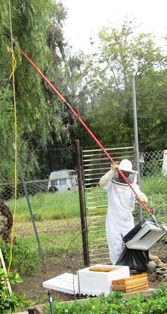
Carlos is preparing to use our neighbor’s makeshift contraption to capture the bees
Carlos volunteered to climb the tall sectional ladder and began to suit up. He would be the rope puller who would shake the limb. The rope was already there thanks to a swarm last year in the same spot.
I wondered if shaking the bees off that high limb would work. They would have to drop precisely into the box that my neighbor would be positioning under the the writhing swarm. What if the bees fell, missed the box, and flew right back up?
Well, it did work. Most of the bees landed in the garbage bag. The bag was duly shaken over the prepared hive. There, the bees stayed. Our neighbor went home to his own gardening chores, and Carlos and I resumed our weeding, albeit in a different part of the property since a few stressed-out bees were still buzzing around that tree.
Streak of Warm Weather Starts Seasonal Bee Swarms
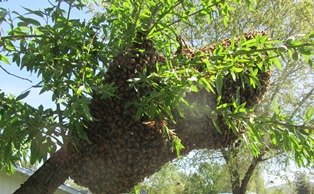
A hefty honeybee swarm alighted in my almond tree
Last Wednesday heralded the official onset of spring. And it sure felt like it around the East Bay. The local beekeepers became more watchful as increasing bee traffic predicted an increased likelihood of swarms.
Last year, we rescued more than a dozen swarms from neighborhood trees as far away as two miles. Bees will fly up to five miles in search of food (they also need water), returning to their hives before darkness and the cool night air sets in.
Swarming is the way honeybees increase their numbers. The queen lays eggs throughout the winter and in spring, the hive will need more room to accommodate all the new offspring. Beekeepers can add “extensions,” but swarms will still happen.
The first swarm of the season found its way to my almond tree on the day before Easter. I had vigorously pruned the branches two years ago after discovering some limbs badly diseased. But the tree rebounded with hundreds of small, thin branches. The weight of the massive swarm caused the branch to give way. The bee swarm fell apart.
In less than a minute, the honeybees were again huddled around their queen on a thicker, stronger branch.
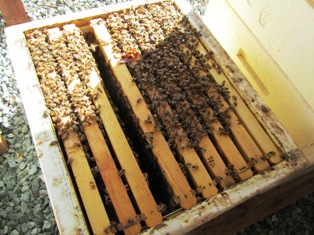
The swarm in its new home
A styrofoam super with frames already inserted was placed under the branch. All it took was a couple of hard shakes of the limb to knock the bees in their new home.
The lid of the super was reattached and the box positioned so that the opening (the bees’ front door) faced the tree. The swarm would find safe haven inside the super as night approached.
After dusk, the super was turned from its western-facing direction to ensure that the bees’ front door faced east, the direction of the sunrise. Bees love the light and warmth of the sun.
Around the top of the super, some of the honeybees did a tail-waggle dance. My beekeeper neighbor told me it was their way of telling the other bees that this was their new home; to, “come on in.”
I guess those little fellows doing the waggle dance were the welcoming party.
Tortoise Alert
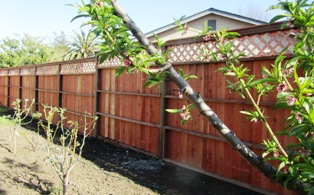
The backside of the fence shows the framing
We have been working like crazy the last few days, busily applying the finishing touches to the redwood fence we are building for our neighbors. We are pushing because they have scheduled a party on Saturday to celebrate the birthday of the youngest member of their family. He turns one year old.
Around noon, above the cacophony of hammers pounding and saws buzzing, we hear our neighbor’s voice call out, “Has anybody seen the turtle?” He was referring to the family pet, an African Spur Thigh Tortoise, who’d taken off from his designated area of the yard and was no where to be found.
We dropped our saws, laid down our hammers, and started searching the three yards that conjoined at a certain point along the fence lines. We looked under the recently raised shed and searched the perimeter of two neighbor’s yards until finally a voice called out, “Found him.”
The pet tortoise had moseyed over to the kids’ play area and had found a shady spot to its liking. There it seemed to be enjoying itself, hanging out, without the concern that its absence was causing its owner.
After a few minutes, Carlos and I and our worker, Alejandro, resumed our tasks. After all, the fence had to be finished. The party was less than 24 hours away.
I had to wonder why the tortoise felt the need to find shade. Its species is at home in the hottest, driest, desert type places on earth, for example, in Northern Africa: Senegal, Niger, Chad, Ethiopia, and The Sudan. But maybe it wasn’t the sunshine it was seeking to escape but rather the noise. I guess we were making quite a racket with our hammers, saws, and shovels.
Springtime Serenades from the Garden
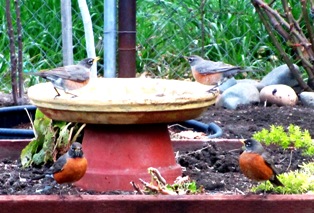
Robins drinking from a pottery saucer
The robins have arrived on the farmette. I’ve been moving dirt with the help of my husband and a worker and there are worms galore. If there’s anything a robin delights in more than dining on a fat, pink worm it surely is singing.
Throughout the morning, I hear its song–cheerily cheerily cheerily as it throws back its head and stands at attention in its red vest and gray-colored waistcoat.
The robin is one reason why I don’t believe in using insecticides for trees and lawns. Rains wash these contaminants into the soil, the earthworms eat the contaminated dirt, and the robins eat the worms. The cycle can be fatal for the birds.
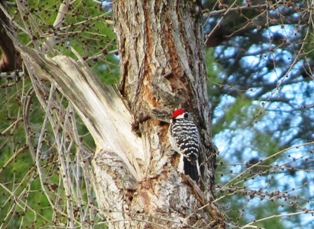
Nuttall’s Woodpecker in an old elm tree
High in an old elm tree with broken limbs and rot in places, a Nuttall’s Woodpecker adds its course drill of pr-r-r-r-rip to the robin’s song. What the woodpecker lacks in beautiful song, it more than makes up in its appearance. This fellow has a black-and-white striped face and back and a bar of black around its eye. Its cap is a vibrant splash of red.
These birds dine on insects from tree bark and frequently build their nests in a dead limb. Their clutch of white eggs hatch in about 14 days and the male shares responsibility with the female in incubating the eggs.
So while the work of moving dirt (so far, digging down to the septic to inspect and reinforce it and moving a section of dirt to the garden to replace an old gravel driveway) is tedious and time-consuming, the serenades of birds in the garden make the effort a bit more tolerable.
A Whole Lot of Coupling Going On
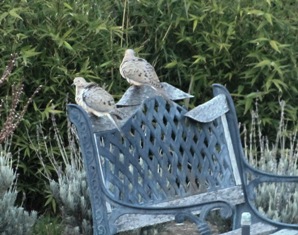
Mourning doves grousing on an old bench after feasting on birdseed
Lately, the way the birds, insects, and wild creatures are pairing up, you’d think we were on Noah’s Ark instead of the Henny Penny Farmette.
I’ve never seen such bird and bee traffic as in the last few days. This morning, I put on the bee suit and joined my neighbor on a tour of inspection to see if the bees survived the cold snap we had a week or so ago. We had snow on Mount Diablo and a hard frost elsewhere. But the bees are fine, and there are lots of babies.
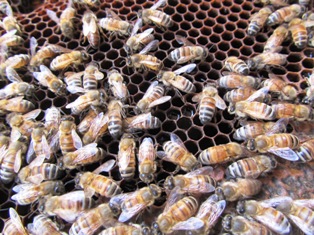
Honeybees make honey and royal jelly for the queen and babies through the winter
Today, the yellow finches are congregating around the Nyjer feeder and singing their little hearts out. There’s a woodpecker in the neighborhood (maybe two). I haven’t seen it/them but there’s a whole lot of tap-tap-tapping in the nearby oak trees.
I often see a flash of blue as I work to move and amend the soil on our property. Last year about this time, pair of Western blue birds were scouting locations for a nest. They are back and I hope they stick around.
The plaintive coo-coo-coo of the mourning doves has become a chorus of late. At first, I noticed a pair in the back yard and now there are several pairs. They mate for life. So we’ve put out birdseed and I fully expect to see a nest or two being constructed in the next few weeks.
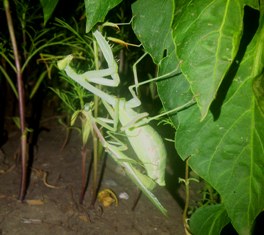
Two praying mantises hanging onto a leaf
Birds and bees are either producing young or making preparations to produce offspring. But the praying mantises? Who knew?
So what I’m taking from all this pairing up is that Mother Nature expects warm days ahead. The wild creatures made it through the winter. No one has to tell them what to do now that spring is only weeks away. Like I said, it looks like Noah’s Ark around here.
Plants Bees Love
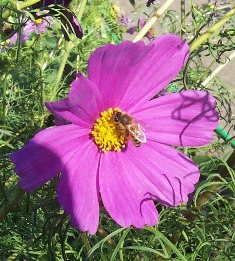
A bee collecting pollen from a cosmos flower
Last summer, I saved the seed from the flower heads plucked out of the gardens around the Henny Penny Farmette (cosmos, zinnia, marigold, nasturtium, and others). Now that the weather has turned warm (and rain is forecast next week), now might be good time to plant those seeds.
I also want to put in some other plants that bees love. People who do not like bees buzzing around can use the list as a reference for what NOT to plant.
Plant open-pollinating plants and avoid hybridized seed that does not have the high pollen content that is most beneficial to the bees. See, http://thehoneybeeconservancy.org/act-today-2/plant-a-bee-garden/
LIST OF PLANTS FOR YOUR BEE GARDEN
abelia, acacia, Arenaria verna, artimesia, aster, savocado
bee balm, buddleia
callistemon citrinius (the bottlebrush shrub), calendula, calluna, ceanothus, Choisya ternata, citrus (all kinds), clover, cosmos, cotoneaster, crataegus
echinacea, echium, erica, eriogonum, escallonia, eucalyptus
feijoa, foxglove
gleditsia
heteromeles, hosta
iceplant
ligustrum (privet), Lonicera japonica (honeysuckle), Lonicera hildebrandiana
murraya paniculata
phyla nodiflora,polygonum capitatum, pyracantha
rosmarinus officinalis (rosemary)
salvia (sage), snapdragon, sorbus aucuparia, syzgium
Teucrium chamaedrys, thyme, Trachelospermum jasminoides (star jasmine)
wild lilac, wisteria, witch hazel
zinnia
While you are busily putting into the garden the plants bees love, why not put out a saucer of water with some large rocks or pebbles for them to stand on while they are drinking? Yes, honeybees get thirsty, too.
The gardens that attract bees are often gorgeous because of all the pollinating the bees do. When you plant the flowers bees love because of high pollen content and provide water, you are not only helping your garden to flourish, you are helping the beleagured honeybees. Our planet needs them.
Bees: Upstairs, Downstairs
A super with nine of ten frames that the bees will fill with honey
My neighbor’s honeybees, just like people, love the warm weather. They’ve been busily scouting out sources of pollen during this past week of springlike temperatures hovering in the upper 60s Farenheit on the Henny Penny Farmette.
I’ve put out a little pottery saucer, the size of a dinner plate, to hold a bit of water for the honeybees who are flocking to the feet of the little angel statue I placed in the center. The bees need something to stand on or they’ll drown. My beekeeper neighbor says wine bottle corks are great for giving the bees a support while they hover near the water to quench their thirst.
Bees, left undisturbed, will build a healthy and strong colony providing they have a food and water source and a a brood box or super in which to live. Of course, they could also take up residence in a hollow tree trunk or other wild place of their choosing. But supers are what beekeepers use.
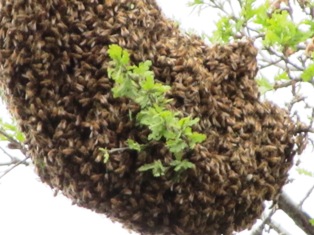
Honeybees will swarm into branches of trees
As the colony grows, the bees will definitely need a super. During the summer months, adding a super on top of the brood box or other super gives the honeybees more room “upstairs.” There, they can store honey while “downstairs” the queen can lay more eggs in the cells of the brood box.
Seeing so much bee activity after a quiet winter, I’m ready to start planting annuals and perennial flowers with high pollen value that attract the bees. More food for the bees means more honey in the hive.
Plants for a Songbird Garden

Finches love black Nyjer seeds produced from blue flowers on tall, feathery stems
If you enjoy songbirds as I do, you might want to plant a garden of flower and herb varieties to attract them.
Include in your songbird garden some perennials and annual plants. The perennials will re-seed themselves or return year after year. Commercial seed companies offer a pre-packaged collection of seeds, but you can also gather your seeds or plants from other sources such as friends, neighbors, and garden club members. I save the seed from many of my plants, dry them, and use them for planting the next year.
Plants might include (but are not limited to) Alcea rosea (common hollyhock, comes in many colors), Amaranthus caudatus (commonly known as love-lies-bleeding), Carthamus tinctoria (safflower seed), coreopsis (tickseed), Cosmos bipinnatas (old flower garden favorite), Delphinium ajacus (blue or purple larkspur), Echinacea purpurea (eastern purple coneflower), Eschscholzia California (California poppy), Guizotia abyssinica (Nyjer seed, often called thistle although it isn’t thistle by an oily seed loved by finches), Panicum miliaceum (common millet), Papaver rhoeas (opium poppy, some types can be as tall as seven feet), and Rudbeckia hirta (Black-eyed Susan).
Birds and bees are attracted to cosmos growing in a garden
The heights of these various plants range from about 15 inches to six or seven feet. The colors are varied, ranging from whites to pink, red, orange, yellow, green, and blue.
The types of songbirds these plants will attract include cardinals, finches, goldfinches, hummingbirds, mockingbirds, warblers, chickadees, wrens, titmice, and thrushes.
Keeping a Garden Ecosystem in Balance
A healthy ecosystem, whether in a forest or a garden, stays in balance in part because of its “grazers” and “predators.” The grazers can range in size from a large plant-eating animal like a cow to a tiny aphid, and predators share this size range, too. Consider for example, a tiger (predator) in a wild, natural environment dining on an antelope (a grazer) or tiny ladybug (a predator for grazing aphids) in a rose garden.
A lush, healthy garden will have an underlying healthy ecosystem. If your garden plants are being devoured by pests, you might want to introduce more of the pests’ natural enemies. For example, if your roses are infested with one or more of the 200 different types of aphids, buy lacewings.
One lacewing larva can destroy roughly 200 pests (and pest eggs) for as long as two or three weeks. The adult lacewings do not kill insects (they suck nectar and pollen), but their larvae will inject venom into aphids and then suck out the the plant grazers’ body fluids, which destroys those pests. Adult lacewings will stick around if there are sources of pollen, nectar, and honeydew. They are beneficial to a garden ecosystem because the lacewing larvae feed on spider mites, mealybugs, leafhoppers, thripes, and other unwanted plant grazers.
Take a stroll around your garden on a regular basis. Take note of its ecosystem. Create a healthy garden using organic products when possible. Remember that plants cycle through seasons. There may be periods of the year when your plants seem to be more infested than at other times. Practice tolerance if an infestation is mild. Let nature run its course. If the balance is right in your ecosystem, the predators will take care of the grazers.