You are currently browsing the archives for the Wildlife category.
Blogroll
 Facebook
 Goodreads
 LinkedIn
 Meera Lester
 Twitter
SITE VISIT COUNTER


Archive for the 'Wildlife' Category
A Swarm in July Isn’t Worth a Fly
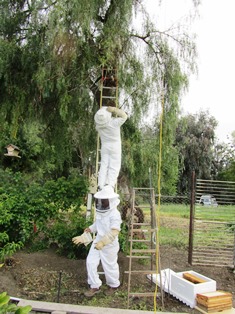
Capturing a bee swarm sometimes requires two beekeepers
There’s an old proverb about bees that goes: A swarm in May is worth a load of hay, a swarm in June is worth a silver spoon, but a swarm in July isn’t worth a fly. You might wonder why.
Well, I asked my beekeeper neighbor that question this morning as we suited up to feed the bees and take some frames of honey. The hives were thriving, bees were active, and the honey production copious. He harvested some, but also left some for the babies that the queen had produced.
There are spring flowers in May and new flowers in June, but by July many of the flowers that the bees love to forage on have flowered and gone to seed. If the queen lays lots of babies, where will the worker bees get enough pollen and nectar to support the entire hive, feed the queen, and supply the babies?
During fall in Northern California, the bees can forage on the eucalyptus blossoms, but then, they must survive through winter. I see bees on my December roses, but there aren’t a lot of flowers blooming in December that have high pollen and nectar loved by the bees.
Swarming in May and June is a sight to behold. Swarming is way the bees of deal with hive/nest overcrowding. It is how they increase their populations. See, http://entomology.unl.edu/beekpg/beeswarm.shtml.
A savvy beekeeper is ready to capture swarms as soon as the weather warms up in late spring. The bees won’t wait, although it is possible for a seasoned beekeeper to anticipate a swarm and take action to avert it. But it doesn’t always work.
An apiarist must manage his or her colony of hives and anticipate the needs and activities of the bees for the coming season–at this time of year, that means during fall and winter. Without a lot of food growing to support a new hive of bees from a captured swarm, a swarm in July isn’t worth a fly.
Skunks Snacking on Bees, Who Knew?
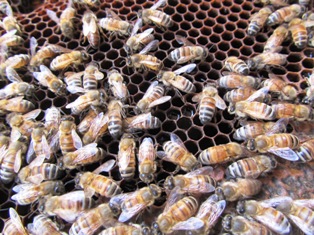
Honeybees make a nice sundown snack for marauding skunks and raccoons
I had to do some searching around the Internet to beekeeping sites to find out whether or not skunks eat bees. Apparently they do.
The way it works, a skunk comes around in the early evening after sundown and will scratch on a hive until the guard bee or bees come straight out and then swats at them before eating the bees. Mother skunks even teach this behavior to their young.
My beekeeper neighbor keeps his hives elevated onto a bottom board platform. One would think this should ensure that the skunks would not bother the hive, but there is evidence lately of a skunk coming around.
Some of the telltale signs that a skunk might be raiding your hives are scratch marks on the hive, muddy prints if there’s a water source nearby, skunk feces (some may have dead bees in it), and dead bees on the ground in front of the hive.
When marauding mammals like skunks and raccoons get a taste for bees, a hive can die. Some suggestions I found searching around on the Internet include putting down tack strips (like those used to install wall-to-wall carpets).
Another is to put a screen around the hives (with an opening at the top for the bees to come and go) or place chicken wire in front of the hives. Skunks like standing on solid footing, not wire or mesh. A roll of mesh at the base of the hive could also be an effective deterrent.
You definitely want to get rid of the skunks. One can decimate a hive in a single night scratching, eating, throwing dirt until the bees get angry and come out in mass and then the skunk has a big meal. The hive thus weakened can be empty within a day or so.
Honeybees Have Distinct Personalities
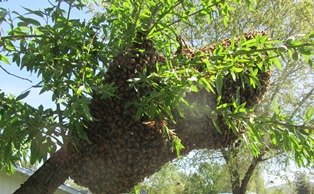
Bees that swarm will follow reconnaissance scouts to their new nest
I don’t wear perfume in the garden least the bees think I’m a flower and light on me. But if they do, I let them walk around and explore. I don’t swat at them. Why would I? Honeybees are generally among the most docile of all bees.
Honeybees also have different personality types, according to research published in 2012 in the magazine Science and based on a study by Gene Robinson, University of Illinois entomology professor and director of the Institute for Genomic Biology. See, http://news.illinois.edu/news/12/0308bees_GeneRobinson.html
Scavenging and reconnaissance work carries more risk and challenge, whether you are human or honeybee. An adventuresome personality is usually best suited for that kind of work. Robinson and his researchers observed that the honeybees that do the nest and food scouting express distinct patterns of gene activity in molecular pathways that have been associated with thrill-seeking.
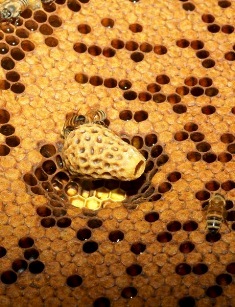
The honeybee queen’s “house”
Whereas the adventurous scouts choose the thrill of taking off, the more intrepid and timid bees tend to stick closer to home, doing the tasks of building the hive, cleaning it, caring for the babies, and making honey. Robinson’s research debunks the ages-old idea that the colony’s workers are interchangeable.
America’s first honeybees arrived in from Europe by ship to the American colonies in the 17th century. It took approximately 200 years for the honeybees to get to the West Coast from that early introduction. Some went feral. See, http://www.orsba.org/htdocs/download/Honey%20Bees%20Across%20America.html
The most aggressive honeybee personality is the Africanized bee (aka, killer bees). These bees attack (often in droves) if they perceive a threat to their nest or queen. See, http://www.independent.ie/world-news/americas/couple-attacked-by-swarm-of-30000-bees-who-kill-their-two-horses-29456104.html
The Africanized bees have spread from Brazil, where honeybees from Europe (highly valued for pollinating crops and producing honey) were interbred with bees from Africa. These bees were inadvertently released in the 1950’s in Brazil and began to migrate north. They are now in Texas, New Mexico, Nevada, Arizona, and California. See, http://bees.ucr.edu/ahb-facts.html
All this information about work and personality types as it relates to honeybees makes me wonder: If we humans suited our work to our personality types, would we work as contentedly as do the bees in the garden and those in the hive?
Paper Wasps Under the Eaves
The small, yellow-striped paper wasps have built two nests under the eaves. These insects are considered agriculturally beneficial, but they tend to get a little too close for comfort. The nests are right above my front door.
The nests are open-cell structures held together by fibers that the queen has masticated from wood posts (and sometimes woody plant stems) and mixed with saliva to create the cells of the nest. The nest can be grow to six to eight inches across in order to accommodate a growing population.
Paper wasps feed their offspring caterpillars, beetle larvae, corn earworms, flies, tobacco hornworms, armyworms, and other insects.
These wasps can sting multiple times, unlike the gentle honeybee that can sting only once. Earlier this year, when we were working on our front windows and door, I was stung four times on my cheek. For people allergic to bee stings, the sting can be life-threatening. It’s recommended to wear a bee suit when removing the nest as the wasps will attack in response to the threat to their nest.
The best time to remove the nest is evening when the wasps are less active and on the nest. High pressure water can be used to knock down the nest. I wrapped a hand towel saturated with a strongly scented kitchen cleaner. I took the nests down and then quickly went back into the house. The next day, a random paper wasp was back, apparently ready to rebuild. What was I to do, but reapply the smelling kitchen cleaner. The wasps are gone now.
Honeybee Disorders and Diseases

Honey (seen at the top) is sealed in comb on a frame that fits into a super
The beleaguered honeybee is threatened from environmental stresses, pests, and diseases that not only can decimate the bees but continually challenge modern beekeepers who must figure out how best to treat the problems.
Beekeepers against the use of chemicals within the hive believe there are other options available for dealing with these challenges such as breeding stronger, more resistant bees. That can take years. Meanwhile, it is important to understand some of the problems that can assail a hive.
Chalkbrood
When you see a frame within the hive containing larvae that have turned chalky white, consider that you are likely dealing with chalkbrood. Infection is by a fungus, Ascosphaera apis, causing the larva to die after its cell has been capped. Only the larvae are susceptible. Healthy hives of bees can usually clean up the problem on their own. Re-queening the hive and rotating out the old comb comprise the best course of treatment.
Nosema
Nosema cerrane is a fungus infection of the adult bee, affecting the intestinal tract that results in diarrhea. The disease can weaken the bees and diminish the health of a hive. Heathy hives can usually fend off and recover from Nosema, but hives that are already week are more susceptible to Nosema infection.
Tracheal Mites
Tracheal mites infect the trachea (windpipe) of honeybees. Look for extended wings (when infected, bees are not able to fold their wings against their abdomens); missing wings, and dead bees on the ground outside of the hive.
Treatment consists of placing menthol crystals in the hive and leaving them for 14 days when temperatures at at 60 to 80 degrees Fahrenheit. The bees breathe in the menthol and mites die. Honey from medicated hives should not be consumed; frames for honey (for human consumption) can be put into the hive three to four weeks after medication is removed.
Alternatively, some beekeepers advocate using solid vegetable shortening and sugar patties, believing the bees eat the sugar and the shortening gets on their bodies making it difficult for mites to reproduce or attach to bees. A commercially available product Apiguard is also effective but must be used as directed. Do not treat when honey flow is on.
Most articles about treating bees with medications also warn that such treatments will contaminate the honey for human consumption and suggest treating bee colonies during certain times of the year, not treating during honey flows. Beekeepers are always advised to use medications according to instructions that come with them.
Varroa Mites
This external parasite of honeybees showed up in hives in the United States around 1980. Facing little resistance from American honeybees, it attacked adult and larvae, preferring drone (male) larvae to worker bee larvae. In addition to the mite’s direct attack on bees, it serves as a transmittor for viruses that can infect bees.
Treatment varies. One is to finely dust powdered sugar onto all the bees so the mite can no longer ling to the bees. Thus losing their grip, they fall off. Another treatment is to insert drone (male bee) comb. The mites prefer the drone larvae ( larger and develop over a longer period).
Once the mites infect the drone larvae, the drone comb is removed and put into a freezer, killing the mites. After a period of freezing, unseal the comb, return to the hive, and healthy worker bees will clean it.
Bee genetics might prove to be effective in the long run for dealing with the dreaded varroa mite. In the Primorsky region of Russia, a strain of bees have been found to be more than twice as tolerant to the varroa mite as conventional bee stocks and also more resistance to the tracheal mite. So after a period of quarantine, these Russian bees are available for commercial purpose in the United States.
Beekeepers can also control populations of mites using miticidal strips. These are hung inside the hive and must be handled and disposed of as hazardous material. Unfortunately, the mites are developing increasing resistance to the chemicals in miticides.
Foulbrood
The spore-forming bacterium Bacillus larvae is the most dreaded perhaps of all bee brood diseases–American foulbrood. European foulbrood is another brood disease of such highly infectious nature as to require the burning of the hive.
In American foulbrood, the bacterium infects larvae up to three days old producing millions of spores. Some bees are more susceptible to this highly communicable disease than others.
Teramycin (oxytetracycline) is the only drug approved to treat American Foulbrood Disorder. Many beekeepers use this drug annually as a prophylactic treatment for their hives. Once a hive is infected, burning the infected hive or hives is the only solution to stop the spreading since the spores can remain viable in honey and the beekeeping equipment for decades.
Note: Recommended reading: Top-Bar Beekeeping, Organic Practices for Honeybee Health, by Les Crowder and Heather Harrel (Chelsea Green Publishing 2012) and Keeping Bees and Making Honey, by Alison Benjamin and Brian McCallum (David and Charles Publishing 2008). See also, http://www.ars.usda.gov/Services/docs.htm?docid=2882
Choosing the Milk for the Cheese …Goat or Cow?
Imagine the taste on your palate of warm figs with a dollop of goat cheese right off the grill, accompanied by a lovely California red wine. Now re-imagine that cheese produced by your own goat. This is my new dream.
For me, the taste of cheese and yogurt produced from goat’s milk is preferable to the taste of the same products made from cow’s milk. Lately, I’ve been considering the pros and cons of owning a goat versus a cow.
My list goes something like this:
Goat:
Smaller (easier to transport, shelter, and handle)
Eats less feed, therefore costs less to keep
Produces less milk (which is an advantage when your family is small and doesn’t drink much milk)
Goat manure is dry (arrives on the ground in pellet form)
Goats are great foragers and keep weeds and grasses nibbled away
Cow:
Bigger (needs larger shelter and transportation)
Eats more, drinks more, therefore costs more to keep
Produces more milk than goats
Cow manure is wet (turns into dry “pies”)
Cows need pasture and feed (cows eat roughly ten times as much as a goat)
I’m thinking I’d need a farm to own a cow; but for my little farmette, a goat makes more sense. As for choosing the type of goat; well, that’s another process. For now, I think I’ll pick some summer figs and melt a little goat cheese on top. Wine anyone?
Wildfire and Record Heat Mark July’s Start
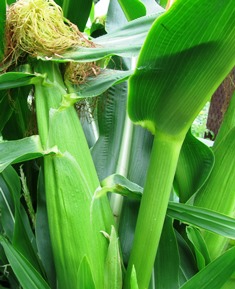
Ripening corn needs water
My corn is drooping, the ears are shriveling, the lush green leaves are beginning to look like oven-roasted kale chips. No question that the early summer heat is taking a toll on my garden.
July is usually a hot month. But here on the farmette this first week of July, temperatures over the last few days have reached 104 degrees Fahrenheit. Five minutes away up on the ridges of Clayton, I have been watering my daughter’s garden, too. Yesterday, over the top of a towering bone-dry hill opposite her house, I caught sight of smoke and local cattle moving down off the hills toward the neighborhood homes.
That grass fire, roughly two miles away from her home, mushroomed into a cloud of smoke. The main artery over those hills, Kirker Pass Road, was closed while firefighters fought the blaze yesterday afternoon. The fire was near the Concord Navel Weapons Station. The winds blow off the Carquinez Strait up through the East Bay valleys in late afternoon each day, and yesterday was no exception. Wind increases the risk that the fire can spread.
As I watered the citrus, I saw helicopters (Cal Fire sent four planes) carrying water overhead to douse the fire. A helicopter passed over about every fifteen minutes. In just a few hours, the blaze charred 492 acres, burned a trio of structures, and threatened some homes. It’s worrisome to local homeowners that because of dwindling resources, Contra Costa County recently closed the fire department in Clayton, closest to that grass fire.
So, we all count ourselves fortunate that local fire fighters and their hard work over the next five hours resulted in a dousing of that fire.
Seasonal Flowers Change the Taste and Color of Honey

Honeybees love foraging in Spanish lavender
If you’ve ever wondered where honey gets its color and taste, think flowers. Or, more correctly, pollen from the flower and herb blooms and tree blossoms.
In the environs that encompasses roughly five to ten miles around the Henny Penny Farmette, honeybees gather pollen from blossoms on lavender, citrus, sunflowers, cosmos, fruit trees, and other flowering trees. Bees collect pollen from cultivated gardens but also from plants growing wild on hillsides and in the meadows and fields.
The first woodland flowers and wildflowers of spring yield honey that is a pale lemon color and tastes sweet and light. Later in the season, the pollen bees collect from citrus tree blooms such as orange blossoms becomes honey with citrus notes and aroma. When certain types of eucalyptus trees bloom in September, the honey takes on a warm amber color and a strong and earthy taste.
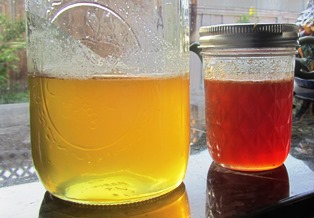
Honey can vary widely in color and taste, depending on the type of pollen the bees have collected
Dark honey is also found in a spring hive. It can be traced to the pollen that the bees have discovered and gathered from blossoms and blooms of flowers, trees, or herbs with a strong flavor and dark color.
If you want the health benefits from honey, purchase the raw honey. Raw honey is high in antioxidants and also has immune-boosting properties, according to Dr. Tasneem Bhatia, from the Atlanta Center for Holistic and Integrative medicine.
In a December 2012 appearance on the Dr. Oz show, Dr. Bhatia recommended people take 1 to 2 teaspoonfuls of buckwheat honey every day as a natural remedy for cold, sore throat, and flu symptoms. See, http://www.prweb.com/releases/honey/buckwheat-honey-raw/prweb10242276.htm
Raw honey means it has not been heated or otherwise adulterated by processes that reduce or compromise the healthy benefits. Beneficial enzymes, propolis, pollen, minerals, vitamins, amino acids, and antioxidants are destroyed when the honey is heated.
Drink your hot tea or warm milk with honey, but don’t put the honey in the cup of liquid and stick it into the microwave. Warm the liquid first, then add the honey.
It matters not whether your taste leans toward the light honey or the dark, the liquid honey or the honeycomb, have some honey every day. It’s good for you.
Getting Stung Is No Fun!
Honeybees
Working outside in my garden, I heard a loud buzz next to my ear and felt a searing pain at the site where my cheek and ear meet. I wouldn’t swat at the bee. I didn’t actually see it. But, boy, did I feel it!
I dashed into the house and my husband removed the stinger. I put an ice cube into a napkin and rubbed the site for a few minutes until the pain subsided. I also took a an antihistamine tablet with diphenhydramine, the active ingredient in Benadryl™.
Here are a few helpful tips if you or someone you know gets stung.
Remove the stinger as soon as possible. The longer the stinger is left in place, the more venom is injected. Use your fingernail or tweezers to get it out.
The application of ice will keep down the swelling. For people over 18 with pain from a bee sting, give acetaminophen or ibuprofen.
Antihistamines can help with the itchiness associated with a bee sting.
For severe reactions or for people allergic to bee stings, seek immediate emergency assistance. Symptoms can include difficulty breathing. rapid heartbeat, tightness in the throat, hoarseness, and anxiety.
If the person stung has a history of anaphylaxis and possesses a doctor-prescribed emergency dose of epinephrine, have him inject the dose or do it for him if the individual cannot.
The Farmette Welcomes a Proliferation of Ladybugs
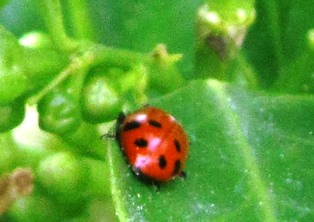
Ladybugs devour large quantities of aphids, a common garden pest
Ladybugs, of late, are proliferating all over the Henny Penny Farmette and on my neighbors’ properties as well. On Sunday afternoon, the young daughters of a neighbor and I spent a lovely hour plucking ladybugs from the grass, placing them upon our hands, and watching them zip up and down our arms.
Ladybugs are beneficial to the gardens. It’s been estimated that during its life that lasts about a year, the average ladybug will consume 5,000 aphids, those soft-body pests whose larvae that dine on tender, young plant shoots.
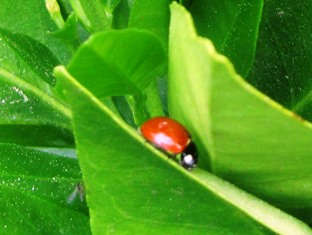
Convergent Lady Beetle hunts for aphids on a blood orange tree leaf
Of the thousands of species of ladybugs in the world, only about 175 are found in California. By far, the Convergent Lady Beetle is most common and highly beneficial to California gardens.
The various varieties of ladybugs and other beneficial insects can keep in check populations of harmful pests so gardeners won’t have to resort to using insecticides and pesticides. A healthy, strong ecosystem is always best for organic gardens.
Female ladybugs are often larger than their male counterparts, depending on the species. Some have spots and some don’t. Their color isn’t limited to just red and orange, but can include a host of other hues. To learn more about ladybugs, see http://www.everything-ladybug.com/ladybug-facts.html.
A daily stroll around the farmette that includes a ladybug sighting tends to make me smile. I might even be heard whispering words of welcome. With the ladybugs here, I feel reassured that my organic fruits and vegetables are a little safer from the dreaded aphids.